



Making the Grade: What’s Right with U.S. Public Education
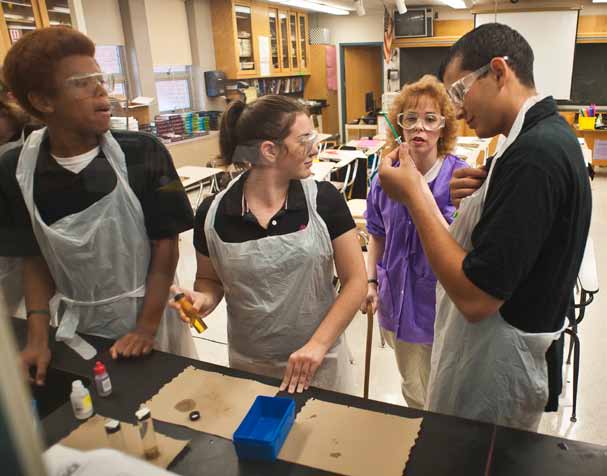
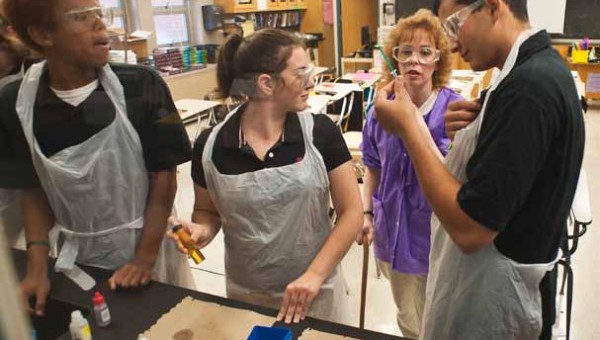
Day in the Life of a Teacher: Science teacher Sherri Svedine-Gaskalka ’92 let a Quarterly photographer shadow her for a day in early September. Her work teaching AP biology and chemistry in inner-city Springfield, Massachusetts’s Central High School demonstrates what high standards, personal attention, and hard work can help students achieve. She arrives at 7 am, teaches six classes and labs a day, eats lunch at her desk, and participates in meetings with colleagues and/or parents after the official school day ends. Then the grading—and preparation for future classes—begins.
Amid the drumbeat of bad news about America’s educational system, Mount Holyoke alumnae are using their skills to make improvements—one student, one classroom, and one school at a time.
When Meredith Louria ’77, an English teacher at Santa Monica High School in California, opened the newspaper early one June morning and saw the advertisement for the movie Bad Teacher, she couldn’t help but cringe. The summer popcorn flick features Cameron Diaz as a raunchy, self-absorbed middle-school teacher who announces that she chose the profession for “short hours, summers off, and no accountability.”
The film is a comedy, but Louria knows that too many people assume that Diaz represents many teachers. “I’m sure there are people like that,” Louria says. “But [the stereotype] makes the movie—it’s not the quiet, effective work that most of us do every day for thirty or forty years.”
Public educators—and the public education system—have been taking a beating in recent years. In many cases, it’s for good reason: statistics suggest that American students’ science and math proficiency is among the worst in developed countries; dropout rates for minority students hover near 50 percent; and the movie Waiting for Superman, a devastating portrait of education in America, sparked a national discussion about how the educational system must be fixed.
There’s no question that there are very real problems within public education. But even as the TV pundits and newspaper editorial writers skewer teachers and schools, the amazing work of many educators bubbles just beneath the surface. Mount Holyoke alumnae are working at every level to make a difference in the lives of individual students, in classes, and in schools. Their work may not make front-page news, but it is effective and inspiring. And their stories provide some of the optimism needed to support real and lasting change.
Thinking Big
Laura Rogers ’72 is codirector of the school psychology program in the department of education at Tufts University. Two decades ago, she was working on the school committee in her town of Harvard, Massachusetts, when a friend and advocate for educational reform, Ted Sizer, urged her to spend a day shadowing a student in a well-respected local high school. She admits she was disappointed. “I never heard a question asked by a teacher or student that couldn’t be answered in one sentence,” she says. “If your aspiration is that students should learn to think critically and weigh evidence, then you should see them practicing that in the classroom.”
It was that experience, in part, that inspired Rogers to become a founding trustee at the F. W. Parker Charter Essential School in Devens, Massachusetts, which opened in 1995. The school followed “The Ten Common Principles of the Coalition of Essential Schools,” which included small student loads for teachers and a focus on helping students use their minds well.
The principles are more than talking points. Advisory periods, in which groups of a dozen students and one teacher meet, bookend each day. Students develop customized learning plans each year and take part in community-service activities. “We wanted a school that would be more responsive to the range of students and their needs as young people,” Rogers says.
Results suggest that the approach is working: students are achieving state-required levels of proficiency and don’t get lost in the shuffle. According to 2010 statistics, about 80 percent of all Parker attendees have gone on to graduate from a four-year college.
Building Better Teachers
As charter schools like Parker seek to redefine the educational experience of students, Karen Bang-Jensen Zumwalt ’65 and her colleagues at Columbia University Teachers College in New York City are finding ways to reimagine teacher education.
For decades, there was essentially one path to teaching: students went to college (and sometimes graduate school) to get certified to teach. It remains the dominant model, but new approaches are starting to take hold.
Teach for America and Teaching Fellows programs, for example, work with recent college graduates and career-changers who haven’t followed traditional teacher-education routes. The programs fast-track members’ preparation, and within a matter of months or even weeks, they can become the teacher of record in classrooms of low-income communities. While such programs can attract a diverse group of potential teachers and fill important positions that might otherwise go empty, this approach has its drawbacks, says Zumwalt. “Because these people are learning to teach while they’re the teacher of record in the classroom, they haven’t necessarily had enough preparation,” she says. “They’re experimenting on very vulnerable students who have great needs—students who present challenges even for very experienced teachers.”
To get the best of both worlds, Columbia recently created the Teaching Residents at Teachers College program, which works much like a medical residency. Students come into the program and get a stipend, a significant scholarship for Columbia’s master’s degree program, and work in a classroom with an experienced teacher for a full year. Zumwalt thinks the hybrid approach might make a real difference, particularly since similar programs in other cities, including Denver, Chicago, and Boston, have
been promising. It’s also helping schools fill positions where there have traditionally been significant shortages,such as secondary special education and Teachers of English to Speakers of Other Languages (TESOL).
While the program is small—Zumwalt expects twenty-five to thirty people to go through the program annually—it is a step in the right direction. “There are lots of good little projects like this going on,” she says. “I hope they will blossom, and become a new model we can use.”
Partnerships that Work
Just a few miles south of Zumwalt’s office at Columbia are the offices of the Fund for Public Schools. Tara Paone ’81, their chief financial officer, has overseen some $300 million in donations received from philanthropists since 2003.
Paone says the public-private partnership is uniquely positioned to offer support to schools that public funding can’t. “What we do is more like research and development,” she says. “The public sector still takes on the lion’s share of what needs to be funded, but private dollars can support innovation, research, and development around ideas that still haven’t been completely fleshed out.”
One wildly successful program that developed with the fund’s support is the School of One, a digital math program that combines teacher-led instruction, one-on-one learning, independent work, and virtual tutoring. Time magazine, which named it one of the fifty best inventions of 2009, called it “learning for the Xbox generation.”
The fund’s current programs are diverse, but “innovation is the common theme,” says Paone. “We’re always looking for ways to support students, teachers, principals, and schools.”
Other major cities with notable philanthropic communities are taking note; recently, the Los Angeles public school system has been looking at developing a similar program.
Best Practices
Grand plans for education are important, but so are the countless daily interactions between teachers and students. These moments—where the chalk meets the blackboard—are what affect students perhaps most directly and deeply. More than 1,400 Mount Holyoke alumnae are currently teaching. Their stories illustrate the power of a single teacher to change lives.
Perhaps one of the most stunning successes is powerhouse Nancy Ahlberg Mellor ’59, who over the past quarter century has been honing a remarkable program now known as CHA House. The program, which she started as a teacher at Coalinga Middle School in California, pulled intelligent—but not necessarily high-achieving—Spanish speaking students into her math classes. There, she pushed them, cajoled them, and dared them to dream bigger.
Along the way, she built a partnership with the University of California at Berkeley. She helped build a successful summer program at the university that allowed these high-potential students to develop their skills and see the possibilities that might exist outside of their tiny farm towns. “I realized that kids can dream about what they want to do, but they can’t do it unless they have the words to dream in,” Mellor says. As a result, students who might have gone back to work on farms have instead pushed
themselves to attend to community colleges, state colleges, and world-class universities. Of the 400 or so students who have gone through her intense program, Mellor estimates that 160 have graduated from college and another seventy-five are currently in college.
Meredith Louria, the Santa Monica English teacher, has taken full advantage of opportunities for fellowships and grants. For example, after a US State Department fellowship in 2004, Louria created a partnership with Nadezhda Strueva, a teacher in Russia. In 2007 she received a grant from Facing History and Ourselves to create a curriculum with Strueva. The two have retooled their teaching to take advantage of that connection. During one unit, her ninth-grade students read a dystopian novel and do a project based on the reading. One option is We, by Yevgeny Zamyatin. “The project for students who read that novel is to ‘talk’ to the students in Russia about the book,” Louria says. Because of the eleven-hour time difference, students write messages to each other online. Technology enables this communication, but it’s great teaching that makes these connections valuable. “Students get excited not that they’re doing projects on the Web; they’re totally excited that they get to talk to their counterparts from another country.”
Beyond the ambitious programs and whiz-bang technology, there is an almost endless number of teachers making a difference in students’ lives through their day-to-day actions. Alexa Encarnacion ’02, a history teacher at the Manhattan Center for Science and Mathematics in New York, says it’s easy, from her vantage point, to see the herculean efforts that most teachers put into their job. Despite constantly changing policies for testing and achievement, despite draconian rules that mean she can’t hug a student for fear of a lawsuit, and despite the constantly increasing class sizes, she says the vast majority of teachers are doing good—if not remarkable—work.
“My [teacher] friend was thirty-eight weeks pregnant, but she kept going to school so she could be there when her kids graduated,” Encarnacion says. “Teachers stay after school working on essays with kids, even if they don’t get paid. I’ve had friends write fifty or sixty college recommendations a year, without any expectation of getting paid.” She says she sees teachers fighting to get the troubled but promising students into AP classes, in which a single spark can ignite a passion that fuels a career. Encarnacion created a race, class, and gender course because students were clamoring to talk and think about issues that weren’t discussed in the available coursework.
Emilie Ronallo ’05, a second-grade teacher at SPARK Academy in Newark, New Jersey, says teachers in elementary schools are making similar efforts. She puts in even longer hours than her students, who are at school for nine hours each weekday, plus Saturday sessions for field trips and supplementary classes for families. Ronallo often visits her students’ homes, and says that her students benefit from all the time and attention teachers spend on them. Indeed, she adds, students often achieve more than they
ever thought possible, such as reading and writing in second languages as early as kindergarten. It doesn’t surprise her. “When you have high expectations of students, they will rise to meet them,” Ronallo says.
Looking Forward
It’s easy to find flaws in the public-education system, but those who work within it also know that there is a great deal of positive change happening. Instead of spending so much time focusing on the failures, many would like to focus on what’s going well—and to scale up these ideas and programs.
For Karen Zumwalt, governments and businesses can do many things, but it’s the people who take jobs in the field who will make the difference. “I meet fantastic people every day who are passionate about teaching,” she says. “And that’s what gives me hope.”
—By Erin Peterson
This article appeared in the fall 2011 issue of the Alumnae Quarterly.
Mercury Rising: What Happened When Lauren Smith Stirred Up the Mud
 Like most waterways, the bottom of the Savannah River is full of dark, mucky sediment.
In 2005, when Lauren Wooten Smith ’11 got down and dirty to analyze what was in that mud, she discovered a toxic metal—methyl mercury—at more than 100 times the level considered lethal.
Muckraking wasn’t on her mind when she set out to measure the heavy-metal levels in the river near her Augusta, Georgia, home. As a sixteen-year-old looking to earn extra credit in a difficult high-school course, she designed a science-fair project to compare mercury levels in sludge samples taken from various spots along the river. Her discovery led to acclaim and a multimillion-dollar environmental cleanup—and some hard lessons about how complex a “simple” research project can become.
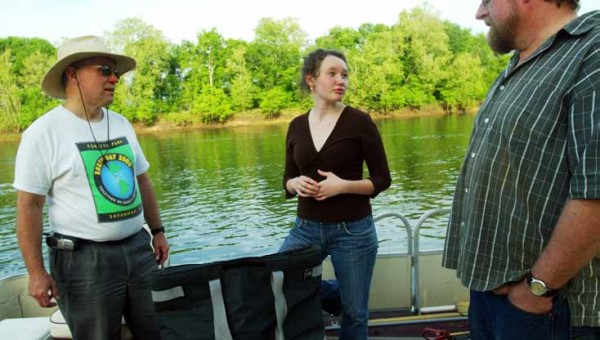
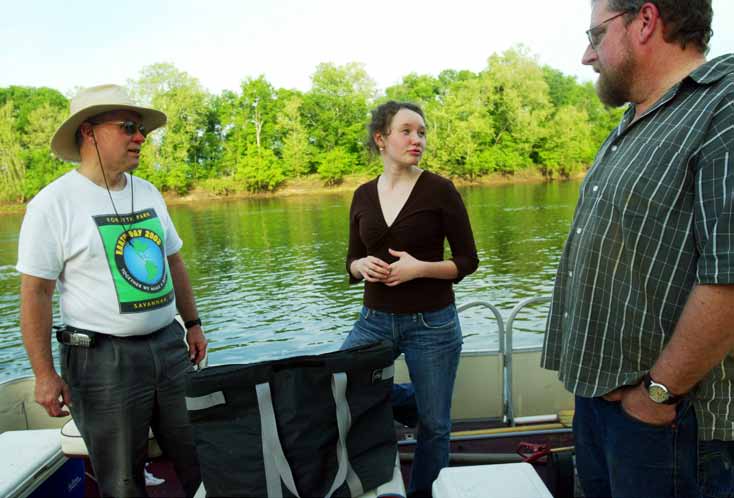
Smith learned that an Olin Inc. chemical plant had for years used mercury in its manufacturing processes and released 500 to 700 pounds of it annually into the Savannah River basin. Curious about the metal’s longterm effects, Smith wrangled a boat and sampled the river mud using duct-taped PVC pipes. To analyze the samples, she needed to use an environmental chemistry lab at a nearby nuclear plant. That required sitting in a classroom (with 100 male truckers!) to obtain special certification in nuclear safety.
What Was in the Mud
The National Oceanic and Atmospheric Administration says allowable levels of mercury in stream sediment can be from five to fifty-one parts per billion. Smith found samples with up to 62,000 parts per billion. “I was shocked,” she recalls. The daughter of scientists—her mother is a nurse and microbiologist, and her father is a physician—Lauren took science seriously and believed her results were reliable. But others doubted that one so young could have done the tests correctly.
Smith says, “Even after an environmental sciences PhD reran all my tests, and even though I was working in a government-certified lab, many people said, ‘Oh, she’s just a high-school student; these aren’t real results.’ It was a sad realization that the science didn’t speak for itself and that who I am had so much to do with how seriously the results were taken,” she says.
But when Smith’s findings were shared at regional, national, and international science-fair competitions, her work attracted attention. “It took media coverage to get the EPA to look into the problem,” she says. When they did, Smith’s findings were confirmed, and cleanup negotiations began among the plant, local government, and the EPA. Eventually, the Olin plant spent $3 million to encase the mercury-laden sediment already in the river channel near the chemical factory. However, the plant
continues to discharge mercury, legally, into the river. Olin is eliminating the use of mercury “over the next two years” at that and another plant, according to a December 2010 article. Olin plants are among the last in the nation to make chlorine using this mercury process. According to the Savannah Riverkeeper Web site, 90 percent of the chlorine produced in the United States is now made using a better, safer process, primarily membrane technology.
Natural Science and Social Science Clash
While all this was brewing, Smith graduated from high school and started her MHC studies, designing her own major in medical anthropology. For her senior thesis, “Embodied Consequences,” she took on a new aspect of the Savannah River project: the human impact of eating mercury-laden fish. “While I was gathering sediment, I saw lots of fishermen on the river,” Smith recalls. “I’d heard people say, “There’s no human impact of the mercury,’ but long-term, large-scale epidemiological studies make it clear
that thousands of children are born every year with adverse neurological effects due to mercury.”
Since the number-one way people are exposed to mercury is by eating fish, Smith set out to study the health of those who live along the river. And this is where the lure of natural science got tangled in sociocultural “fishing line.”
Her research plan seemed straightforward—measure the mercury levels by analyzing hair samples—but cultural misunderstandings profoundly affected Smith’s work.
Here she was—a young, white, middle-class college student—trying to reach a group that was largely retired, male, poor, African American subsistence fishermen. Perhaps miscommunication was inevitable, but Smith didn’t expect the reception she got. “I walked along the river where people commonly fish, and asked people for hair samples,” she says. “One of the first things said to me was, ‘You’ve got to be crazy if you think I’m going to give you my hair. Don’t you know about the Tuskegee syphilis experiment?”
This kind of reaction was no surprise to Smith’s senior thesis adviser, MHC Professor of Anthropology Lynn Morgan. “Natural science is done by humans in a specific context, so it is invariably influenced by social, political, economic, educational, and media contexts as well as by the identities of research subjects and the researchers,” she explains.
Some feared Smith would use the hair samples to do drug testing; some community members practiced voodoo and believed that giving someone your hair gives them power over you.
Smith admits she didn’t have a truly representative test group. The people who agreed to donate hair samples tended to be white as well as wealthier and more highly educated than the average resident in that area—and more likely to eat sushi than river fish. For her control group, Smith used hair samples from a local barbershop. So the demographics of the two sample groups weren’t comparable. And, although she found higher mercury levels in the test group than in the control group, her small sample size prevented drawing broad conclusions.
She was on safer ground with the second part of her study—evaluating the effectiveness of “fish advisories,” government messages intended to inform residents how much of each local fish they can safely eat. Smith discovered that these advisories weren’t reaching the intended audience, for several reasons. The fish most often eaten weren’t always the ones tested. Advisories were often not posted at all, and when they were, not everyone could read them. And the “safe to eat” levels assumed people consume fish far less often than many families along the Savannah River actually do—typically twice or even three times a day.
At every turn, Smith discovered another issue. “Doing a senior thesis was a great learning experience,” she says. “Now I know how to develop a study for this population.” Adviser Lynn Morgan notes that, “By picking such a complex topic, Lauren didn’t take the easy way through her senior year. It’s a real testament to her courage and intellectual vision that she insisted on combining academic disciplines to achieve a more holistic and complex understanding of the effects of mercury contamination on ecological and social systems.”
From Fish to Breastfeeding
Now a graduate, Smith’s new direction builds on her previous work on nutrition in at-risk communities. Funded by a Fulbright grant, she left for Bangladesh this past summer to boost the number of new mothers who start breastfeeding their babies shortly after birth. (The sooner breastfeeding begins,the better a baby’s chances of survival.)
After the Fulbright year, she will begin an MD/PhD program, then do maternal and child health work internationally. That’s the plan. No doubt there will be unexpected eddies in the river of her career, but trust Smith to follow the current wherever it may lead.
—By Emily Harrison Weir
This article appeared in the fall 2011 issue of the Alumnae Quarterly.
See a video about Smith’s work at mtholyoke.edu/news/stories/5682859.
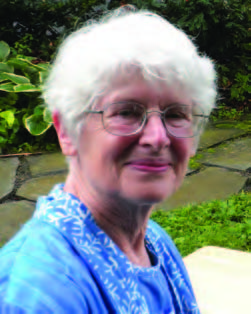
Judith Voris Reppy ’58: A Dedication to Peace is Honored
Professor Judith Voris Reppy ’58 was greeted with a standing ovation. A celebration in April 2010 marking the fortieth anniversary of Cornell University’s peace studies program coincided with the retirement of the professor emerita—a fitting occasion for renaming the program the Judith Reppy Institute for Peace and Conflict Studies.
Founded during the Vietnam War, Cornell’s peace studies program has evolved into an energetic graduate studies institute offering courses and research opportunities in arms control and disarmament, civil-military relations, terrorism, and post-conflict reconciliation, to name a few. An inherently varied form of study, peace studies attracts multiple sectors of academia including anthropology, science, sociology, and even music.
For example, Judith noted that a PhD candidate is currently writing a thesis on the image of a symphony orchestra as a metaphor for eighteenth-century political discourse. “In almost any discipline,” Judith says, “you’ll find a substantial body of scholarship concerned with peace issues.”
Judith’s journey into the field of peace and conflict research began with her economics degrees—as an undergraduate at MHC, earning an MA from Yale, and later receiving her PhD from Cornell. When looking for a job teaching economics, Judith hit a wall in finding available positions. However, Cornell offered her a position as research associate in their new peace studies program.
“Economists interested in peace studies were in short supply, and they needed one,” she explains.
During more than thirty years at Cornell, Judith’s courses have run the gamut of government studies, science and technology, as well as economics—all related to the politics and policies of war and peace.
“The reason I’ve stayed with it and am so happy to have a career associated with the peace studies program is that there’s a lot of work to be done—with policies that can be applied, addressing questions that actually matter.”
When the idea of naming the peace and conflict studies institute in her honor arose, Judith admits to being caught off guard. But she came to realize that, with the trend in naming centers and buildings after financial donors, to have Cornell distinguish one of their own was laudable. “It’s a good idea to recognize a foot soldier occasionally.”—K.H.
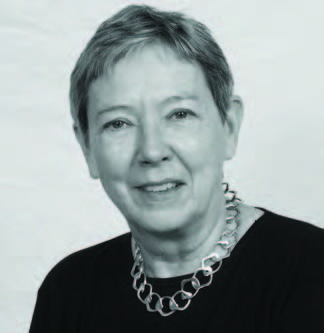
Roberta Aber ’65: Supporting Family Planning Against All Odds
When Roberta Aber ’65 graduated from Mount Holyoke, birth control—even for married couples—was still illegal in a number of states. “I myself was denied birth control in Massachusetts in late 1967,” Roberta remembers.
This personal experience, as well as her drive to give women legal access to family planning, led her to Planned Parenthood, where she worked for almost three decades. In 2009, she retired as CEO of the Akron, Ohio, office after twenty-six years of service.
Roberta’s dedication to the organization is evident in her efforts to provide access to family planning and sexual-health services to hard-to-reach and at-risk men, women, and youth. Her outreach work recently inspired a fund created in her name, The Roberta Aber Fund for Outreach Services, which will ensure that reproductive-health services continue to be provided to underserved populations in the Akron area.
Roberta’s commitment to the organization also comes from an awareness of the dangers of not having access to family planning. “Unintended pregnancy is the greatest single reason that women drop out of school or become dependent on welfare,” she says.
The federal family-planning program that has helped countless young women fulfill career and educational goals is under threat in Congress, she says. In late winter, the Republican majority in the House voted to take away the $75 million in federal
funding that Planned Parenthood receives annually.
Cecile Richards, president of the Planned Parenthood Federation of America, calls this vote the “greatest legislative assault on women’s health in Planned Parenthood’s ninety-five year history,” and Aber echoes this sentiment.
“Here in the second decade of the twenty-first century, while most people take reproductive-health services for granted, these services are under the greatest political threat I have seen in my adult life,” Aber says.
Historically, though, Aber says that women fought back against these kinds of limitations. “Their struggles were often secret and unsuccessful, but women everywhere participated in the struggle. Just because it was illegal didn’t alter women’s determination,” says Aber, suggesting that determination is once again necessary.—Maxine Getz ’13
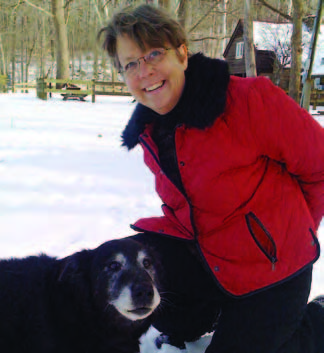
Lisa Pantzer ’74: Lie down. Roll over. This won’t hurt. Really.
Not too long ago, a couple brought a dog into the Indiana veterinary clinic of Lisa Pantzer ’74 that they had found on the side of the road. He had been hit by a car, had broken ribs and a badly shattered bone just above the elbow joint that’s hard to heal, was old and nearly blind.
The couple didn’t have enough money to pay for her services, so Lisa agreed to treat the dog as best she could, for free, and then find him a home. (Veterinarians are softies, if you haven’t yet made their acquaintance.)
Normally, Lisa said, you’d amputate the leg on such an old dog. But his long body and short stature would not work well on just three legs so she pinned the broken bone, treated him homeopathically for pain, and took “Colin” home.
Six weeks later, she took the pins out and today, she says, he “can’t see but can spot me anyplace, can’t hear but can hear me call him, and can track my scent through woods and streams and fields.” Pantzer attributes his amazing turnaround to the holistic medical approach she and a sizeable number of veterinarians are now using.
After almost twenty years of working as a traditional vet for some of the best horse farms in Kentucky, and often accompanying horses owned by royal families in the Middle East, Lisa now focuses her one-woman practice on homeopathy, acupuncture, and Chinese medicine.
While she was interested in meditation in college and introduced to Chinese healing in veterinary school at Purdue University, it wasn’t until she started raising sheep organically that she began to experiment with the curative powers of homeopathy, or profoundly diluted medications.
Little lambs that had fallen under the feet of her horses and were badly injured bounded off following homeopathic treatments. She was sold.
Acupuncture on a dog? Sure, says Lisa. “I put needles in them and they like it. They roll over and expose different parts of their body.” She starts each visit with Qigong, an ancient Chinese technique to collect and move Qi, or energy, with her patients and their caretakers.
Lisa is now learning more about using quantum mechanics, or the fact that all things in the universe are linked, as a healing modality in her clinic and at home is practicing biodynamic farming, which uses the principles of homeopathy on the land.
“I’m really still growing and still learning,” says Lisa. “I am doing what I was going to do when I graduated from MHC…just not how I thought I was going to do it.”—M.H.B.


