



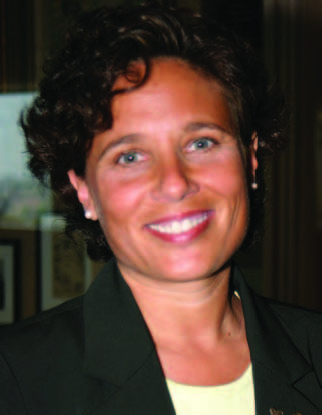
Amy Pellman ’82: A Voice for Justice
When she was a student at MHC, Amy Pellman ’82 served as president of the Student Government Association. But she discovered her real passion for human rights, and the rights of one fellow alumna in particular, working for Amnesty International in the summer of her junior year.
Iride del Carmen Marasso Beltran de Burgos ’76 was a supporter of Archbishop Oscar Romero, the revered advocate for the region’s poor. She and her husband and son had moved to Guatemala following the archbishop’s assassination in El Salvador. Like millions of her countrymen targeted for their prodemocracy leanings, de Burgos and her son were allegedly abducted, or “disappeared,” by the Guatemalan military in 1981.
Amy got wind of Iride’s situation and made it her personal goal to shed light on the case and the ongoing struggles for freedom in Central America. Back on campus, she circulated petitions, gathered donations for Amnesty International, and worked to bring the atrocities in Guatemala to light through letters and articles.
Tragically, Iride was never found. But almost thirty years later, Amy is still working in the name of justice as a family court judge in the Los Angeles Superior Court, where she spends her days defending the rights of children.
Before assuming her current position, Amy worked as an attorney advocating for foster children and parents in dependency court. She found that the rights of foster children remained a relatively unexplored area of law, and that the lawyers involved in those cases had very little training or information. She developed a training manual.
“Children in foster care have no voice,” Pellman says. “They have been taken away from their family for abuse or neglect, they are vulnerable and extremely underrepresented.”
Amy also served as the legal director for the Alliance for Children’s Rights, which provides legal services for impoverished and abused children. She helped found National Adoption Day, which opens up courtrooms across the country on the Saturday before Thanksgiving to finalize adoption papers and help provide thousands of children with homes.
Today, as a family law judge, Amy handles issues ranging from multimillion-dollar property divisions to custody battles. But she remains focused on the rights of those whose voices, like Iride’s, are often absent.
“My courtroom is child-centered, not parent-centered,” she says. “Children are always the first priority.”—Cass Sanford ’10
Kristin Colvin Young ’97: Master of "Invisibility"
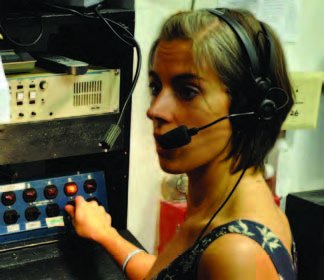 If Kristin Colvin Young ’97 does her job well, no one will notice. As stage manager for the Alvin Ailey American Dance Theater, she is in charge of everything an audience experiences except for the actual dancing. From the reminder to turn off cell phones before the curtain rises to the last curtain call of the night, Kristin “calls” the performance from her backstage perch.
And nothing happens on stage until she cues someone to make it happen. “I run a tight ship,” she says. “If we have two minutes to make a change, we’re ready in one. The audience shouldn’t notice anything except ‘That was amazing.'”
A dance and sociology double major at MHC, Kristin impressed choreographer David Parsons during an internship at Jacob’s Pillow, and wrangled a job as company manager/assistant stage manager for Parsons Dance Company the fall after graduation. Running shows during Parsons’s US, South American, and European tours gave her a trial by fire, but Kristin found she liked and was good at the work.
Calling performances for Ailey—while intense and exacting—is only the “cherry on the top” of Kristin’s total responsibilities, which involve “organization, delegation, communication, and lots of paperwork and computer time,” she explains. Minutia—such as booking studio space or organizing the company’s rehearsal schedule—balance in her brain with big-picture concerns that include organizing future schedules up to a year in advance.
In the past decade, she’s also toured with Ailey in Asia, Europe, and America. Tours typically last five to ten weeks, so Kristin’s adapted to life on the road. But during her precious down-time she loves to relax in her NYC co-op apartment or be pampered at a spa on St. Lucia.
Audiences rarely think about the backstage work that makes onstage performances flow seamlessly, but they continue to respond to the Ailey company’s artistry, which Kristin calls “comfort food for the soul.”—E.H.W.

Letting Go of the Body Myth
“I’m just trying to change the world one fat girl at a time,” Gabi Gregg ’08 writes in the Young, Fat, and Fabulous blog she’s been churning out since graduation. Gregg is determined to make a difference in the lives of disenfranchised women everywhere: “girls like me—the ones who are so in love with an industry that is, well, not so in love with us.”
Fashion isn’t for fat girls.

And yet there’s Gregg, decked out in urban chic, to-die-for shoes, and stylish bling—all designed to show off her curves. At twenty-four, Greggs pretty face, with her apple cheeks and radiant smile, has already graced the cover of Black Enterprise magazine. She’s been quoted in the New York Times and has appeared on “Good Morning America.” And last January, she won an online contest to become MTV’s first “TJ”—Twitter jockey, with a $100,000 contract.
Gregg’s triumph of self-acceptance is all the more remarkable when you consider that she once “hated shopping” and tried “dozens” of diets in high school. Like many women, she was plagued by the “body myth,” a term coined by psychologist Margo Maine. The problem, as Maine explains it, is that we’ve come to believe—wrongly—that “our self-worth and worth to others is based on how we look, what we weigh, and what we eat.”
Indeed, it’s hard for a woman to get through the day without encountering images of buff bodies and flawless faces—looks that 95 percent of us can never achieve. How can we not be disappointed at what we see in the mirror?
Even Mount Holyoke graduates—savvy, independent-minded women, many of whom are steeped in feminism—aren’t immune.”I am utterly baffled at how, despite my gaining a top-notch education from a college that teaches us how to be strong and empowered women, I still manage to put most of my self-worth into what someone else thinks of me,” writes account executive Catherine “Cat” O’Brien ’03 in a Facebook post.
And it’s a lifelong struggle. “You have to come to terms with yourself again and again,” observes Caroline Carlson Jorgensen ’97. “Aging is my recent issue—seeing lines on my face that weren’t there.” We didn’t become a weight-obsessed society overnight. Historians date the beginning of the “diet ethic” to the late nineteenth century, when Americans became more sedentary and rich foods more accessible. But in the last thirty years, says literary historian Elena Levy-Navarro ’87, editor of Historicizing Fat in Anglo-American Culture, standards have become more unattainable. A generation ago, fashion models weighed 8 percent less than the average woman; today, they weigh 23 percent less.
Meanwhile, the $60 billion “weight management” industry is taking our insecurities to the bank. Most weight studies are funded by pharmaceutical companies and other businesses that profit from our panic. Dismayed by our expanding waistlines, we are easy marks for “scientifically proven” weight-loss regimens, products, supplements, and surgeries that promise to melt off the pounds. When one “fix” doesn’t work, we become anxious and depressed, blame ourselves—and then try something else.
So how did Gabi Gregg manage to defy the body myth? She was probably born resilient. “Gabi’s always known what she wanted,” says her mother, Sharon. Gregg also credits MHC for helping her find her voice. “Being in an all-women’s environment empowered me,” Gregg says. “I didn’t go to class worrying about my body or what I was wearing.” The Internet played a vital role as well. “People underestimate how important social media and online connections can be. In high school, I began blogging about myself on LiveJournal.” In her first year at college, she met other “fatshionistas” online. “I became convinced I didn’t have to be the fat girl who wore oversized tees and sweats to cover up my body.”
Gregg also stands on the shoulders of other MHC alumnae—women like Mary Duffy-Guerrero ’66. As the daughter of a hypercritical mother who “kept herself thin on cigarettes and Dexedrine,” Guerrero was put on a scale every Saturday as long as she lived at home. She became a “problem eater” early in life. “I was either on a diet or counting calories or binging,” she says. In college, such things were not discussed. “The message was, you could be fat and get a PhD, but no one would love you and want to be with you.”
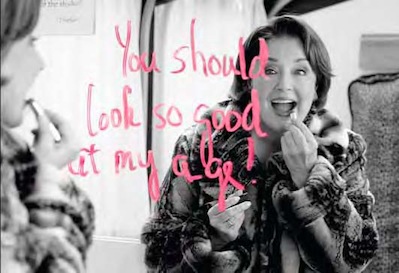
Mary Duffy-Guerrero ’66, an early plus-size model, later founded the first plus-size modeling agency-Big Beauties. Now sixty-five, she owns Fashion for the Rest of Us aimed at the fashion, beauty, and media-image needs of women over fifty.
After graduation, at 5′ 6″ and weighing 150 pounds, Guerrero landed a job posing for the first Jordan Marsh department store plus-size catalog. “It was a rush to become the woman who made 40 million large-size women feel good about themselves,” she says. She then parlayed her visibility into founding the first plus-size model agency—Big Beauties. “I was the un-Jane Fonda, the Eileen Ford of large sizes.”
“I started the business out of rage,” Guerrero recalls. “Strangers would come up to me, and say, ‘You’d be really beautiful if you’d lose weight.’ Magazines ran headlines like, ‘Will Fat Sally Go to the Prom?’ It’s the duty of any educated woman to do something about that.”
Three decades later, many are. At MHC, student athletes aren’t subjected to weigh-ins. Body image is openly discussed among students, coaches, and counselors. And students who are passionate about these issues can join EveryBody, a campus organization that fosters self-esteem and size acceptance. The goal, explains its first cochair, Amanda Braga ’10, is to “convey a message that is seldom said to women, which is to love your own body instead of striving to have someone else’s.”
The message is spreading nationally as well, thanks to increasingly vocal size-acceptance activists, authors, and health professionals. “The consequences of obesity have been greatly exaggerated,” says Ellen Perrella, head athletic trainer at MHC. Yes, sedentary people—who often are overweight as well—are plagued by health problems. But correlation isn’t causation. “It’s fitness that matters, not weight,” she says.
Having seen “no improvement” in the preoccupation with weight and body image during her twenty-seven-year tenure, Perrella concludes, “We need a revolution.” To be sure, we”re up against some mighty economic and societal forces. But as the second-wave feminists were fond of saying, “The personal is political.” Revolutions begin when we question the status quo and change our own attitude and behavior. “If we put our money, time, and energy into health, politics, or world peace, instead of into what we
look like,” says Perrella, “the results would be staggering.”
Here are some ways to reach a “revolutionary” goal—liking your body.
“Think more about maintaining the machine than the coat of paint.”
So says small-business attorney Freya Allen Shoffner ’76, who has struggled with a negative body image her whole life. She suggests avoiding the mirror and concentrating on how you feel. “Do you feel charming, interesting, engaging? Then you probably are, and the rest doesn’t matter.”
Gabi Gregg discovered a way to use the mirror for positive affirmation: “Stand in front of it every day and find one good thing about yourself.”
But don’t expect miracles. “Some days I feel great,” says Caroline Jorgensen, who writes about her daily ups and downs on her Morningside Mom blog. “Other days I feel that my leftover baby belly will never go away.” Her antidote: Staying active and on top of what she wants to accomplish in life, which boosts her self-confidence. “When you feel good about yourself inside, it works its way out.”
Understand where your negative self-messages come from.
Freya Shoffner had an impossibly beautiful mother, a “delicate” sister, and a grandmother who repeatedly described Freya as “heavy, big, and strong.” Kids beat her up just for being different. “By the time I got to college, I’d internalized their voices,” she says.
Now she tries to be kinder to herself. “How I describe my looks depends on whether I’m using the words my therapist trained me to recite—’tall, slender, and attractive’—or what’s in my head: ‘tall, heavy, odd-looking, and old-looking for my age.'” It has also been helpful to revisit her past. As a child she’d imagined herself as a “rhinoceros,” and was shocked when she recently looked at an old photo. “There I was, at age eight, in my brand new Girl Scout uniform. I was scrawny!”
Another way to hush the critical chorus is to find a body-image buddy—a fellow foot soldier with whom you can share war stories. Jorgensen found several when she blogged about her struggles. And Gabi Gregg says, “I still heavily identify with my community of plus-size followers.”
Find your set point.
From 40 percent to 80 percent of how you burn calories is determined at birth. Each of us has a set point—”the weight you maintain when you exercise moderately and listen and respond to your body’s signals of hunger and fullness,” says Ellen Perrella.
We also have a genetic blueprint for strength and flexibility. If two people do the exact same fitness regimen, their bodies will react differently because each has a different “thermostat,” says Jeanne Friedman, head crew coach at MHC.
Drop “diet” from your health strategies.
“Dieting is worse than the condition it’s supposed to cure,” says Perrella, noting that chronic dieters are eighteen times more likely to develop an eating disorder. “Dieting and binging go hand in hand,” she adds.
And diets often don’t work. In one review of thirty-one obesity-treatment studies, subjects lost 5 to 10 percent of their starting weight in the first six months, but most of them gained it back; and within four to five years many regained more than they’d lost. “When you deprive yourself of a basic need,” Perrella explains, “you learn not to trust your body, and it results in overcompensation.” The alternative is “attuned” eating, which means following your body’s cues—eating when hungry, stopping when full.
And many people who think they should diet are already in their own set-point range, which is another reason diets “fail.”
Exercise, but not to lose weight.
“We are never going to be happy if we just think about weight,” says Perrella. And while

Freya Allen Shoffner ’76, who has long struggled with a negative body image, advises looking inward. “Do you feel charming, interesting, engaging? Then you probably are, and the rest doesn’t matter.”
physical activity is essential, it’s easy to slip into a more-is-better mentality. “I don’t think we have a team at MHC that isn’t struggling with these issues,” she adds. “We’re worried about our athletes wanting to be too small. They know they need to be fit and strong, and at the same time they’re open to all the images society shows us.” Embracing the idea that fat and fit are not mutually exclusive, MHC promotes the Health at Every Size (HAES) philosophy, which centers on size acceptance, attuned eating, and adding physical activity to your everyday routine.
“Walk, dance, do what you love. Enjoy your body and what it can do, but don’t connect it with weight loss,” agrees Elena Levy-Navarro, who has yo-yoed between anorexia and obesity since college. “It’s so important to get out there and move.”
Hit ’em with your pocketbook. When you pour money into the weight -management industry, it’s like consorting with the enemy. Instead, reward enterprises that go against the cultural grain. Buy magazines that feature images of older women and plus-size models. Support responsible companies that diversify their ads, such as Dove’s “real women” campaign.
Our voices—and our dollars—matter, as Gabi Gregg has shown. In 2009, when she saw no other “plus-size girls” at a conference that brought together style bloggers and retailers, she organized her own fatshionista conference—a series of meet-and-greets to convince retailers that many fat girls also have fat wallets.
Mediate the messages.
The body myth “poisons” girls at younger and younger ages, says Perrella. “My ten-year-old daughter already wants six-pack abs.” Recent studies suggest that 50 percent of girls are unhappy with their bodies, and 80 percent of US teenagers have dieted. So when you pull up those tight jeans, don’t exclaim, “Oh my God, I need to go on a diet!” Instead, say something positive about yourself. Eat and exercise sensibly. Talk about what healthy bodies can do, not what they look like.
Most important, tell your daughters that they’re good, strong, brave, and beautiful just the way they are. And remind them, as Mary Duffy-Guerrero points out, “Mattel made Barbie, but God made us.”
—By Melinda Blau
This article appeared in the spring 2011 issue of the Alumnae Quarterly.
BUSTING THE BODY MYTH
For links to a five-step plan for “Combating Popular Media and Saving Your Health” and other positive-body-image material, visit alumnae.mtholyoke.edu/bodyimage.
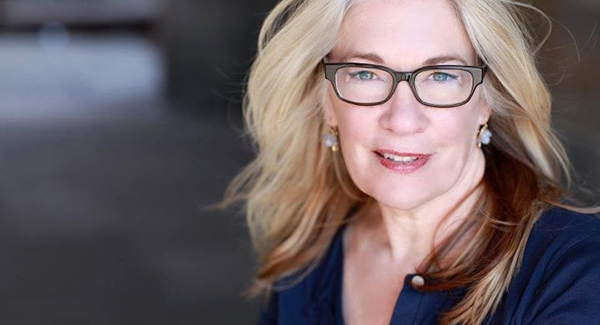
Crusading For a Cause
After suffering personal loss, alums reach out to help others
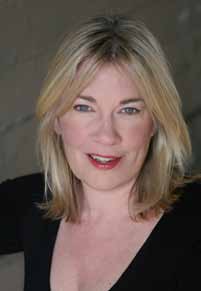
Deborah Morosini ’80
Deborah Morosini ’80 is a doctor. She appreciates logic and has a great deal of respect for science, but in certain areas of her life, she finds little need for cold, hard facts. She knows what she knows, and it is this: when she has a question, her sister, Dana, always has an answer.
That has, perhaps, been the mortar holding together the proverbial bricks of her life for the five years since Dana’s passing. Without such blind trust, Morosini might not have made it as far as she has. And she has made it far.
After Dana died of stage IV lung cancer in 2006 (just a year after their mother died, and two years after Dana’s husband, actor Christopher Reeve, died), Morosini might have been most comfortable crumpled up on the floor. She had every right to grieve.
But what she chose, instead, was to increase awareness of the cause of her sister’s death, one even Morosini didn’t fully understand. Most people don’t understand lung cancer, and they certainly don’t know that the disease can touch healthy nonsmokers such as Dana. Morosini’s commitment to raising awareness is why she isn’t crumpled up on the floor. She is, instead, fighting—fighting for Dana’s memory, and fighting for the lives of those who still have a chance.
As someone genuinely interested in the stories of others, Morosini is a natural advocate. She pursued a master’s in social work at New York University because she wanted to understand the stories that created people’s lives, then help change those stories. During medical school, she worked as a national sales manager for a prestigious textile company, traveling the East Coast to tell the story behind each piece of fabric.
She became a pathologist because she loves science. She uses the microscope to tell a story about a cell or a piece of tissue. As a principal pathologist in oncology research and development for AstraZeneca pharmaceuticals, she works with colleagues around the world, talking about oncology drugs and influencing opinion with stories about her research.
Influencing others requires confidence, skill, and a desire to share what you know. Often, it requires changing people’s minds. And that can change lives. Getting to the life-saving part, however, can be tricky, particularly when the subject is muddied by misinformation and social stigma. “Smoking is one of the causes of lung cancer, and when you’re told something is bad, you think if someone is doing it, they’re bad,” Morosini notes. “When I was a medical student, I used to wonder why I had to take care of people who did this to themselves, but, really, the message is that no one deserves cancer.”
The larger message is that lung cancer can affect anyone. Morosini’s sister had not been exposed to any contagions linked to the disease, save for occasional second-hand smoke. She lived a clean life.
Lung cancer doesn’t seem to care about clean lives; healthy, nonsmokers are not immune to the disease. According to the Lung Cancer Alliance, lung cancer is the leading cause of cancer death in women in the United States, claiming the lives of more women each year than breast, ovarian, and cervical cancers combined.
That was shocking news even to Morosini. “I read the New York Times. I’m a doctor. My father is a doctor. My sister died of lung cancer. If I’m this ignorant, there must surely be a lack of general awareness,” Morosini reasoned.
There is also a lack of funding. Until 2009, the Department of Defense, which allocates money for cancer research, allocated no money for lung-cancer research. In 2009, $20 million was allocated, and last year, Congress appropriated an additional $15 million for lung-cancer research. Any funding, where there was once none, is a big deal. More research dollars lead to better treatment, which leads to better survival rates.
This significant leap forward is due, in no small part, to work from passionate advocates such as Morosini.
During the last five years, she has traveled from Santa Fe to Indianapolis, Oklahoma City to Capitol Hill, giving speeches and serving as guest of honor at more than thirty hospitals, press clubs, benefits, and conferences. She has appeared on television and on the radio, and is on several boards focused on lung-cancer awareness and research. She has devoted countless hours of her own time—beyond her day job—to the cause, increasing the visibility of the disease by sharing her sister’s story.
Her indefatigable spirit seems to run in the family. Morosini’s brother-in-law was Christopher Reeve, best known on film as Superman. After a riding injury left him with a severe spinal cord injury and unable to breathe without the help of a tube, Morosini’s sister Dana fought alongside him, for six years, to increase funding for spinal-cord research. Together, they changed the way the medical field understands and treats the injury, raising money, awareness, and hope.
Only nine months after Christopher’s death, Dana fought her own battle. By the time she went to the doctor to discuss a persistent cough, she had seven months left to live.
Morosini knew she wanted to honor her sister’s memory, and could think of no better way of doing so than by telling Dana’s story to as many people as possible. By connecting with people’s love for Dana, she could use that energy to move them to action.
“When I started this, I thought a lot about the state this disease was in,” Morosini recalls. “This really is about moving mountains, and is what Chris had to do with spinal cord injury, a disease no one really studied. I asked myself how Dana would do this. She would be inclusive, accessible, and loving. I tell her story as a way of engaging people’s hearts. When people’s hearts are open, they are emotionally with you. I tell them I need their help. This is my call to action.”
Her sister would be proud.
“As a scientist, I don’t talk much about my spiritual side, but I feel it’s so important, and has stayed with me this whole time,” Morosini explains. “I hear Dana’s voice. I feel very much like all of my steps have been guided by asking my sister what I need to do.
“If you’re doing this without a connection to your soul or a greater wisdom, this is just dirty work. To be inspired to do this, there has to be an element that is nourishing to you. This isn’t fun. It’s complicated and confusing, and can be really discouraging. The way I’ve found to go through it is by speaking my truth.”
That truth is also Dana’s truth, and the truth of millions of others living with lung cancer. That Morosini has stepped up to represent an underrepresented population speaks volumes about her belief in the power of overcoming challenge with conviction. It’s a challenge for the long haul, to be sure, but Deborah Morosini is ready. With Dana by her side, everything is possible.
FIGHTING for What Matters
Deborah Morosini isn’t the only alumna turning a personal challenge into a wider cause, going to great lengths to fight for what matters. Here are glimpses of five others and the issues they champion.
 Kristin Davis ’88
Domestic violence survivor
When you’re an intelligent, confident woman, cowering in the corner of your bathroom, fearing for your life, you have a choice to make. Stay and die, or get out and live. Davis chose the latter, and is helping domestic violence victims find the strength to do the same, through her blog, orderofprotectionsurvivor.blogspot.com.
 Kate Robotham Conway ’98
Breastfeeding advocate and educator
When Conway was told she couldn’t nurse her own child because of her Crohn’s disease medication, she turned the personal challenge into a quest to educate mothers, physicians, and hospitals about the benefits of breastfeeding. Gradually, myths about the practice from the medical community, formula companies, and society at large are becoming less pervasive, and many doctors who previously handed out formula kits are now distributing her Boobies for Babies kits. Read more at mymammasmilk.com.
 Alice Bertholin Rice ’05
Activist for bone-marrow donation
Bertholin Rice’s sister Denise was diagnosed with acute myeloid leukemia just five weeks before her wedding. Denise needed a bone-marrow transplant, but could not find a match, due to her mixed race. Bertholin Rice started a campaign, encouraging bone-marrow donations from mixed-race individuals, and registered more than 500 people. Sadly, not a single one was a match for Denise, who died last August. Bertholin Rice is now part of a cancer steering committee at her company that focuses on organizations offering resources to those with cancer. She continues to advocate for bone-marrow donation. Read more at jointeamdenise.com.
 Kathy McGuire ’67
Educator and creator of a program for those with ADHD
When McGuire’s son was labeled as having Attention Deficit Hyperactivity Disorder (ADHD) in first grade, she searched for ways of encouraging his normal, active, hands-on learning style. She found that, while some teachers and administrators were willing to work with his learning style, many were not. McGuire had to advocate heavily on behalf of her son, and faced many setbacks, but learned to celebrate her successes. She turned her frustration into a self-help business model designed to teach people new and creative ways of focusing and finding acceptance in their unique learning styles. Read more at cefocusing.com.
 Andrea Beach Morton ’05
Connecting women who have experienced pregnancy and infant loss
After the loss of her son by miscarriage in May 2010, Morton was left feeling alone and heartbroken. She turned online for help and met a woman who started a Web site, Faces of Loss, Faces of Hope, after losing her daughter. They teamed up to grow the site, which offers women a place to share their stories and find support from others suffering pregnancy and infant loss. Their Face2Face program offers support groups for women across the country, and they are working on a booklet for hospitals and clinics to give to women who have experienced a loss. Read more at facesofloss.com.
—By Stefanie Ellis
This article appeared in the spring 2011 issue of the Alumnae Quarterly.
For more about Morosini’s work raising awareness about lung cancer, visit deborahmorosini.com or lungcanceralliance.org. To share your crusade for an important cause, visit alumnae.mtholyoke.edu/goodcause.

Funteller Thomas Jackson Brings Gospel Singing Home: A Voice of Promise

Funteller Thomas Jackson FP’94 leads a lecture/concert in Professor of Religion John Grayson’s Spirituals and the Blues class.
When Funteller Thomas Jackson FP’94 was a child in Detroit in the 1950s and ’60s, the thing she wanted most in the world was to sing like Mahalia Jackson, the “Queen of Gospel.” And she had the pipes to make that wish seem realistic.
Even as a youngster singing in the church choir, Funteller Thomas had a voice to be reckoned with, and her grandfather recognized it—”saw my gift,” as she recalls. He enrolled her in singing lessons, which cost $12 a week—a steep price to pay for a man with few resources. But he looked to the future, and what he saw pleased him.
“His plan was that I would be greater than Mahalia,” Jackson told members of Professor of Religion John Grayson’s Spirituals and the Blues class last fall. And he figured that with the fortune her fame delivered, Jackson could support him in his old age.
It was a good plan, but life—or God, as Jackson would have it—had something else in mind for both of them. Jackson’s beloved granddaddy died soon after her fourth singing lesson—her last, as it turned out—and she never did become more famous than Mahalia.
But listening to Jackson—a recently ordained Baptist minister, who is now associate minister and choir director of Mt. Zion Baptist Church in Altoona, Pennsylvania—sing her favorite gospel songs, it’s easy to understand her grandfather’s early optimism. Powerful and stirring, hers is a voice of hope and promise.
Presence of the spirit
A counterpoint to the strict rules and format of worship services throughout most of the nineteenth and twentieth centuries, gospel was a way to “infuse black religion with soul,” Grayson told his class, which gathered for Jackson’s performance at All Saints’ Episcopal Church in South Hadley.
Thomas Dorsey (not the big-band leader) is credited with being the father of gospel music, which combines Christian praise with the rhythms that were flourishing in blues joints and jazz clubs in the 1920s and ’30s.
“Gospel embraces a belief that the spirit will not ascend without a song,” noted Grayson. “It demands that we all respond to the presence of the spirit.”
As if on cue, Funteller Jackson’s voice then rose from the back of the sanctuary with the passion of someone to whom the song’s title, “I Know I’ve Been Changed,” spoke deeply and personally.
Born to a family with strong Christian faith, Jackson was the eldest of five children. Her dad, a janitor, died when she was fourteen. Her grandfather and uncle, with whom her family had lived, died not long afterward in an automobile accident that also badly injured her mother and aunt.
Acquaintance rape and divorce later in her life pushed Jackson to despair, but it was the news of her youngest son’s death in the airplane bombing over Lockerbie, Scotland, in 1988 that ripped her life apart. It takes nothing short of a miracle to recover from the violent death of one’s own child, and Jackson credits gospel music for leading her, if not to wholeness, then to hope.
“It’s been a long journey,” Jackson told her audience in South Hadley. “I am here today after living a life of pain and suffering. In the midst of it all, I still found joy. Through it all, my faith, the word of God, and gospel music have kept me going.”
Freedom in song
At the outset of a ninety-minute performance that combined gospel singing and lecture, Jackson encouraged the students and old friends in the sanctuary—including its rector Tanya Wallace ’94, a friend and classmate of Jackson’s; accompanist, friend, and former MHC dean of the sophomore class Ruth Bass Green; and Professor of Religion Jane Crosthwaite—to say “Amen” and “Praise the Lord” and “Thank you, Jesus” as her fellow African-American parishioners would in response to the music.
She hastened to add that no one should say anything they found uncomfortable. But it was hard to find anyone in the sanctuary who didn’t at least murmur, if not whoop or even weep with support and appreciation for the joyful performance of this deeply motivated and moving singer. “I feel like when she sings I hear her soul,” said Wallace.
Christine Kobyljanec ’11 was particularly taken with the art of gospel song and the personal style that Jackson brought to the music. She noted, “I like the freedom and fluidity of gospel songs; they’re very improvisational and natural.”
In fact, Jackson noted, gospel’s rhythm is always personalized by the singer’s speech, walk, and laughter. “One of the important pieces in singing gospel is where you are in life on the day you’re singing,” she said.
To the hoots and hollers of students in the pews, Jackson then sang “Amazing Grace” her own way, and then again with the special twist that Aretha Franklin, the “Queen of Soul,” might afford it. “You see the difference?” she asked the excited crowd. Oh yeah, they murmured with delight.
Jackson was forty-five when she arrived at MHC as a Frances Perkins scholar and was “scared to death.” She had worked in municipal government in Detroit for more than ten years, had not been to school since she was eighteen, and—as many nontraditional students do—felt deeply inadequate intellectually. She shared her feelings with Grayson, who suggested that his class Spirituals and the Blues, with its familiar themes, might help boost her confidence.
While it was tough at MHC to be an African-American woman who had never had much contact with whites, Jackson told students the good news was that she experienced being black in a different way. “There were things about my history that it took coming to MHC to find out,” she explained. “I found Caucasian friends—they liked me and I liked them. I was the first FP scholar to be the baccalaureate speaker,” she added.
That speech cinched Tanya Wallace’s understanding of Jackson’s magnetism and leadership abilities. “She’s not just a person with a voice, but someone who radiates what we aspire to,” said Wallace.
Jackson and her husband, Jackie Jackson, joined hands. Together, they sang “Highway to Heaven,” arm in arm, full of spirit, voices filled with hope and promise.
—By Mieke H. Bomann
This article appeared in the spring 2011 issue of the Alumnae Quarterly.
Experience Funteller Jackson’s singing, and learn more about gospel music, at alumnae.mtholyoke.edu/funteller.