


Karen Jennings Lewis ’74: Working for Change in the Schools
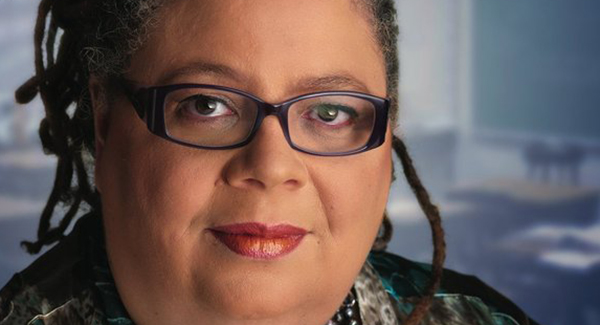
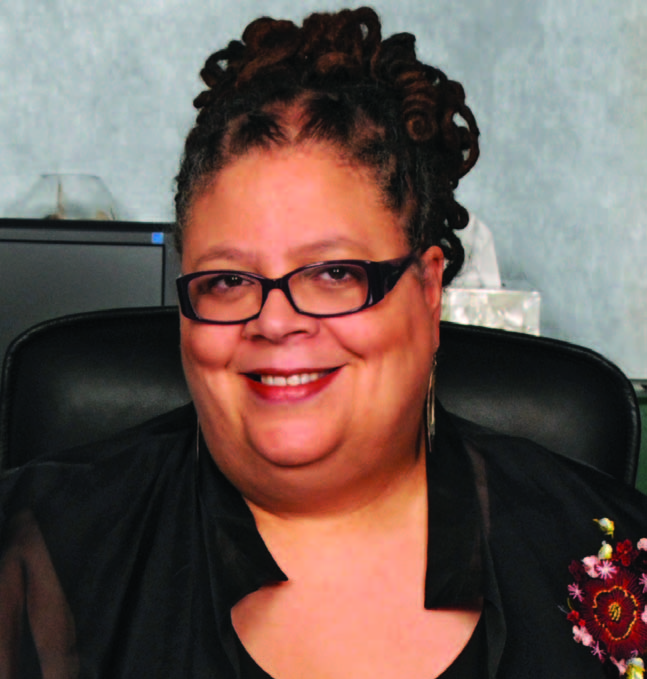 The new president of the Chicago Teachers Union called from the airport. Her schedule is hectic, but busy as she is, Karen Lewis ’74 says she always stops to smile at a passing baby. This is fitting for a woman so entirely focused on the education of young people.
A classroom teacher for twenty-two years, Karen became head of the union last summer at a time of an estimated $600 million budget shortfall and the threatened layoff of hundreds of teachers. When school closings began and Karen found that union leadership wasn’t doing enough to stop the bleeding, she helped start the Caucus of Rank and File Educators.
“Either stand up or don’t,” says Karen. Mount Holyoke, she adds, “taught me you can do anything…to use your mind well…to express yourself.” The key to creating change within the system is for the union “to become an advocate for students, parents, and communities,” she says.
It was with this mindset that she decided to take on the job as president of the teachers’ union. Overseeing 30,000 members is no small task, and Karen has formulated a challenging agenda.
“We want to change the model [of the union],” she says, “to work together, raise the bar on teaching. Lots of emphasis is placed on teachers, but we want to raise the entire profession.”
Karen wants to “make good citizens” of students, which she believes is done best in the classroom. But it takes more than standardized tests to fashion the next generation of leaders. “When you ‘teach to the test,’ there is no learning. How does that help you once you leave?” she asks.
The union presidency has a three-year term. There’s lots to be done, many planes to catch, and more babies to greet. Quoting the Broadway musical, Wicked, Karen says, “It’s about defying gravity—just close your eyes and leap!”
—By Laurel Rhame ’12
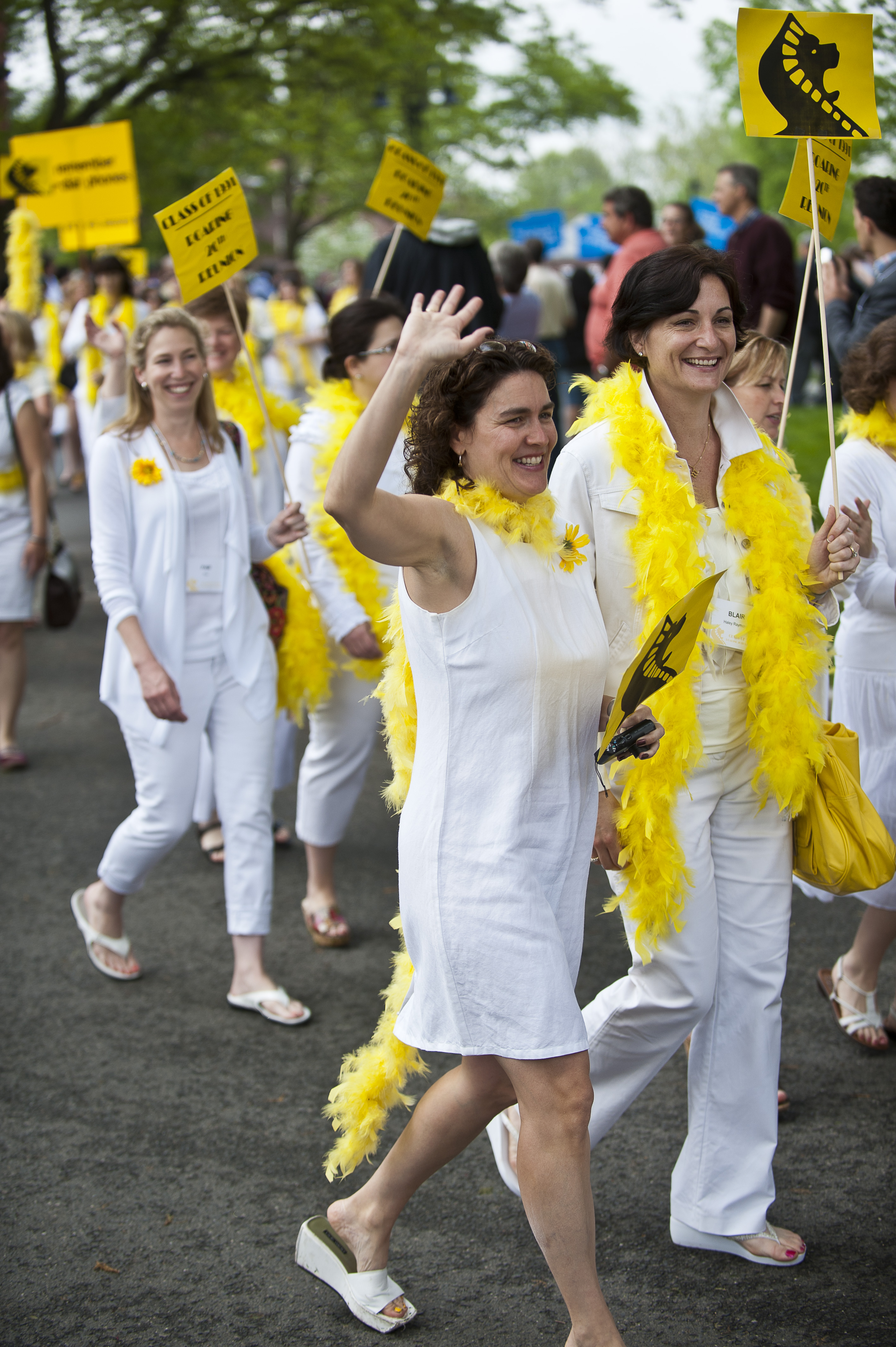

Books or Bytes: Are You Ready For The Future?
Libraries are serving lattes and muffins, and local bookstores seem to be going the way of the blacksmith shop. Last summer, Amazon announced that e-book sales outpaced hardcover books by almost two to one. And several companies are developing ATM-like machines that dispense print-on-demand books instead of $20 bills. We can’t help but wonder, will books even exist twenty years from now?
“I’m not sure yet what the digital revolution has done,” admits Deb Futter ’80, vice president/editor in chief, hardcovers for Grand Central Publishing, “and I don’t think anyone is. It’s still happening. Everyone said television was the end of radio and that didn’t happen.” The industry powerhouse is married to a writer, William D. Cohan. “During our discussions about the future of the book, despite being on different sides of the business, we both believe that the book will live on, certainly in our lifetime.”
The question is, in what form? It’s all happening so fast, even industry insiders can only guess. Lane Zachary ’75, a literary agent in New York and Boston, predicts that in twenty years, hardcover books will be extinct. “Technology is going to take us someplace dramatically different. We’ll have paperbacks and something like the Kindle, which by then will be seen as a dinosaur.”
The shift already happened in the music business, says Zachary. “At one time, everything was the album, then eight-tracks, cassettes, CDs, and now downloads. I see publishing as having a similar arc, and we have to reinvent ourselves to keep up with these changes.” Traditional publishers have been “slow to adapt,” agrees Priscilla Painton ’80, editor in chief of Simon & Schuster’s adult trade division. “But over the last two years, a whole new industry has come into existence to produce new digital products that we’re still calling ‘books.’ Also, the devices are getting better and appeal to all age groups.”
Digital natives, who’ve grown up with computers, eagerly embrace e-books. When Simon & Schuster put its teen readers’ book club online, providing e-versions instead of print books, its membership soared from 3,000 to 20,000 in one year. “More and more preteens are online now,” says Bethany Buck ’84, a vice president and publisher in Simon & Schuster’s children’s book division. “Digital opportunities give us a way to be more creative. In the future, kids might have multiple versions of the same story. And picture book e-books are likely to be significantly different—tons more content and additional features in digital form. It’s not a paperback and not a hardcover. Writers have to think of it as another format.”
Although e-books now account for only 10 percent of book sales, Forrester Research predicted that 10.3 million people in the US would own e-readers by the end of 2010, up from 3.7 million in 2009. Even now, says Dan Visel, researcher at the Institute for the Future of the Book, “Almost everything that’s ever been printed is available to anyone with a computer.”
But what does this all mean to aspiring writers? There is definitely more competition, and fewer traditionally published books make it to market. Publishers and agents are less likely to take a chance on an unproven novice. Advances are also lower, and the quick read seems to be edging out books that require more time and contemplation.
“It’s a different world now than when I sold my first novel in 1996,” says Zachary. “It’s harder to sell literary fiction. Editors want blockbusters, and now that the economy has truly declined, it’s even more difficult. Editors that I once worked with on literary fiction are now cookbook editors.”
With fewer magazines and newspapers, fewer ad pages, and more journalists freelancing, it’s even worse for nonfiction writers. “I got to the party just as they were closing the open bar!” quips Christine Muhlke ’92, food editor at the New York Times. “It’s a competitive market without the kind of outlet for good writing that we’ve had in the past. Now I’m telling top writers, ‘We can give you $50 for a blog post.'”
A key advantage of technology is that it broadens the definition of a book and makes the reading experience more social. Writers can interact with readers in ways that were impossible in the past. “Authors have become real people,” says Buck, “not just photos on a jacket.”
Some authors enjoy the give-and-take. “It’s why you write: to connect with people, to grow the mind, and to have a dialogue,” says mystery writer Sibella Connor Giorello ’85. “Over half the people I’m friends with online are readers.” Giorello believes we’ll also read more because of digital readers.
“This could be a golden age to be a writer,” she adds, “because you can also self-publish, which means you’re not beholden to a gatekeeper to tell you if your book is worthy or not.” Priscilla Painton agrees, “It’s going to be harder and harder to say, ‘I wrote a great American novel, but I couldn’t get it published.’ A good novel still has to be a good novel to be read very widely, but there are more mechanisms now for getting attention.”
How Writers Can Thrive in the New Word Order
Whatever route you take, the going will be a bit smoother if you prepare for the trip. Here, then, is “W-R-I-T-E”—a compendium of advice from alums who have been in the trenches.
Write
To state the obvious, writing takes skill, knowledge, and practice. “Too many people who aren’t qualified want to write books,” says Lane Zachary. “I get so many manuscripts from people who have never studied the craft, yet they want to write books about being in prison or overcoming a disease. Most of the time, these manuscripts serve as therapy for the writer, but they are not well-told stories that are ready for publication.”
Corinne Demas, a widely published MHC professor of English, has mentored many now-successful writers and editors. “Our students are lucky because they’ve had workshop experience. They know how to look at a text. Critiquing other people’s work helps them become better writers.”
Carol Higgins Clark ’78, author of thirteen bestselling mysteries, stresses that “the business of writing may have changed, but the part about learning how to tell a story hasn’t.” Find a writing class in your area, she suggests, “where you can get constructive feedback from a writing teacher.”
Blogging is a good way to practice the craft and to “have the most people possible look at your work,” adds Christine Muhlke. “Editors look at blogs. I’ve definitely assigned pieces based on them.”
Read widely, and expose yourself to a variety of styles and types of writing. Even if you’re drawn to a particular genre, says Muhlke, think of your writing as a retirement fund: diversify. “Advances are a quarter to a third of what they used to be. You can’t just write books, just copyedit, just blog, or just write for magazines. You can’t put your writing all in one place.”
Research
“If you want to be a smart author,” says Bethany Buck, “get to know the trends.” Also read what’s already been written on your topic. “You have to make sure you have a unique idea before you make a pitch,” says Muhlke. “I can’t tell you how many people send ideas that were in another magazine.”
Educate yourself about the business, too. “Start in a bookstore,” suggests Rebecca Fabian ’07, a sales assistant at Beacon Press who previously worked at Barnes & Noble and the Odyssey Book Store and interned at Houghton Mifflin. “It’s a great way to get to know the publishers and what they print.” Read trade magazines, too, to learn about advances, royalties, rights, and other aspects of the business.
Know your options. Most publishers don’t accept unsolicited manuscripts, so if you go the traditional route, you’ll need an agent. If you decide to self-publish, know what you’re in for. Who will edit and format your manuscript and help you market the book?
Writers Marketplace is a classic source of information; so are college connections. Deb Futter landed her first job at Bantam Books “because the person who needed an assistant had previously hired a Mount Holyoke grad.” When Karen Tucker LeFrak ’69 was working on her third children’s book earlier this year, MHC’s Office of Development suggested Professor Demas. “I asked her about the number of manuscripts you can present at one time, how long it takes to hear back. As a seasoned writer, she was a person I could trust as a friend in the field.”
Interact
Thanks to the Internet, the twenty-first century is all about connections—blogs, authors’ Facebook pages, and myriad other reader/writer “communities.” Most sites allow you to comment or at least be a fly on the wall. If you’re skittish about socializing online, think of it as a big cocktail party, and do what you’d do in person: make interesting comments, ask thought-provoking questions, seek help when you need it. Find favorite sites and drop in when you can. Becoming part of the conversation not only eases the loneliness of the long-distance writer; you also gain a posse of like-minded comrades.
Tech-ucate Yourself
Karen LeFrak was taken aback when her publisher first asked, “Are you going to join Facebook?” LeFrak was inspired by a real-life experience to write her first book, Jake the Philharmonic Dog. “It combined all of my passions—education, music, and dogs.” She went on tour, and the book did well. But that was 2004. For her newest book, Best in Show, she needs “an online presence.”
If you haven’t sampled social media yet, it’s time to “techucate” yourself. Start by writing a pithy profile of yourself to establish your online identity. Learn the mechanics of posting. Sites like Facebook make it easy; blogging software is a little trickier, but not hard. And if it all feels overwhelming, find a mentor who’s half your age.
“These skills are mandatory for writers today,” says Christine Muhlke. “I wouldn’t even look at a resume from someone who didn’t have online experience.” Social media can also help you tighten your prose. “Younger writers are already succinct, because they’re used to tweeting. It’s surprisingly useful.”
Brevity is also essential when “pitching” an idea. “Do everything by e-mail,” Muhlke suggests. “Editors and agents don’t answer the phone.” But even with e-mail, she adds, “you have about two seconds of attention. I can’t tell you how often editor friends and I have said, ‘It was a good idea, but it took a page to get to.'”
One caveat: The demands of social media leave less time for writing. “If Hemingway were alive today, they’d be bitching because he doesn’t have a blog,” jokes Giorello, mindful of the new expectations.
Edit, and Experiment
Professor Demas gives the same wear-two-hats speech to today’s writing students that she always has: Write “joyfully” and without constraints. However, once your story is on paper, step back and put on your editor’s hat. “Ask yourself, ‘Who’s my audience, what am I trying to accomplish, and what can I do to make this clear and original?’ Be objective. Make believe it isn’t yours anymore.”
Still, in the current publishing climate, writers also have to think outside the book. “Digital readers are going to change what we write,” Giorello predicts. The new formats, which allow you to research as you read, says Dan Visel, promote a more distracted, but also a more informed, kind of reading. “Readers will expect hyperlinks within a novel,” says Giorello. “For example, when my character mentions a mineral, sodalite, the reader will want to click on it. It’s almost like putting a bibliography into a novel.”
Of course, it also depends on the type of book you’re writing and your target audience. But given the new possibilities, why not ask yourself whether photographs, links, videos, or even games might enhance your text.
Be creative in marketing your book, too, because it’s increasingly harder to get, and keep, readers’ attention. “The challenge is trying a whole palette of ways to sell books,” says Painton. “I see that as an advantage. But it depends on whether you choose to see the glass as half empty or half full.”
None of us knows what lies ahead, but, as Lane Zachary points out, “You can never stop progress. We have to be open to new possibilities and not be frightened by them.”
—By Melinda Blau
This article appeared in the winter 2011 issue of the Alumnae Quarterly.
MORE OF THE WRITE STUFF
For Writer’s Digest’s latest list of the top 101 Web sites for writers, and other tips, see alumnae.mtholyoke.edu/writestuff.
Her Name Was Bette: An Illuminating Account of Disease, Family, and Forgiveness
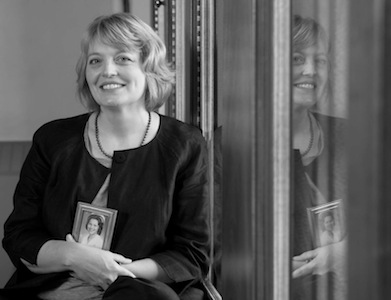
Sherri VandenAkker ’87 displays her mother’s photograph.
To celebrate her tenth wedding anniversary in 2007, Sherri VandenAkker ’87 and her husband, Malcolm, drove west from Boston to retrace the events of that memorable day. They had married in Abbey Chapel and VandenAkker wanted to savor, once again, a sunny, fall day on campus.
They had just begun their walk when she got the call. It was the police, telling her they were about to break into her mother’s house. No one, including VandenAkker, had been allowed inside for sixteen years. Bette VandenAkker had lived as a virtual recluse; her days spent drinking Canadian Club whiskey, her mind, body, and household crumbling around her as she refused all visitors.
What police found that day was a scene that no daughter should ever have to witness. Her mother was dead, her body badly decomposed, and her house literally filled to the rafters with garbage and excrement and empty bottles of booze. It took a hazmat unit three weeks to clean the premises. The few personal effects Sherri now cherishes had to be decontaminated before they were given to her to keep.
The horrific circumstances of her mother’s death and the complicated feelings that VandenAkker experienced afterward led her to make an hourlong documentary, My Name Was Bette: The Life and Death of an Alcoholic. A professor of literature at the School of Human Services at Springfield College in Boston, she teamed up with Boston University film major Josh Hays to coproduce the film.
Through interviews with Sherri, her sister Krystyn White, and their mother’s best friends, the film lovingly outlines Bette’s personal journey as an independent woman of the 1960s and ’70s who was derailed time and again by circumstance, depression, and chronic substance abuse. Photos of Bette as a vibrant, young woman are contrasted with a numbing picture of her bloated face taken following her arrest for driving an unregistered, uninsured car near the end of her life.
But the film is also intended as a broad examination of the effects of alcohol on women, specifically, who are 50 percent more likely to die of the disease than are men, because of their slower metabolism, hormonal system, and social tendency to drink in secret. VandenAkker’s mother also had problems with her eyes, her heart, her balance, her stomach, and her sense of smell, and she had panic attacks.
“I wish I had understood earlier that it’s a disease” that affects every system of the body, Sherri VandenAkker said. “One of my goals is to make sure this is well known; not to proselytize about drinking, but to make people aware.”
By the end of Bette’s life, VandenAkker had come to the realization that “whatever pain she caused people, [Bette] was suffering so much more profoundly.” Now a joyful mother of two herself, Sherri has come to “a profound forgiveness and appreciation” of the person her mother was before alcoholism, she says. “I’m so sad at what she missed.”
—By Mieke Bomann
This article appeared in the winter 2012 issue of the Alumnae Quarterly.
Find out how to see the film by contacting thebettefilm@gmail.com.
Is Being Lesbian Hazardous to Your Health?
A pioneering alumna doctor delivers a mixed prognosis
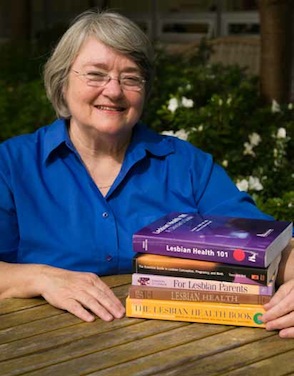
Dr. Patricia Robertson ’72
The state of lesbian healthcare is like the classic cartoon in which a doctor says to a patient, “Well, I have good news and bad news …” According to Patricia A. Robertson ‘72, a physician and professor in the Department of Obstetrics, Gynecology, and Reproductive Services at the University of California–San Francisco, the good news is that lesbians are no longer totally invisible to the medical community. Research has revealed many areas in which lesbians’ health differs from straight women’s health, and those differences have important implications for treating individual patients. The bad news is that research findings about lesbians’ health are sobering.
While all women have the same basic anatomy, research has shown that, when compared with straight women, lesbians
• are less likely to get regular health screenings;
• are more likely to smoke, become depressed, abuse alcohol and other drugs, and be overweight;
• are more likely to develop breast cancer and possibly ovarian cancer;
• are more likely, as young women, to have unintended pregnancies;
• are more likely, as young women, to develop the sexually transmitted infection Chlamydia, which can cause infertility in later life;
• are as likely as heterosexual women to be the victims of domestic violence.
Yet even those discouraging findings represent progress, Robertson says, because just a few decades ago, there was no scientific research about what health issues might be more common in lesbian patients.
Robertson remembers how frustrating it was to talk about lesbian health as a young doctor in the 1980s. “In my work as an obstetrician-gynecologist, I used research studies to justify how I provided care to my patients, but I didn’t have evidence-based guidelines about lesbian health then. All I could say to other practitioners was, ‘Be nice to your lesbian patients.’”
The Center for American Progress notes just how little research has been done on LGBT health: A review by Ulrike Boehmer of twenty years of medical research revealed that only 0.1 percent of the 3.8 million citations published between 1980 and 1999 related to LGBT issues. And 80 percent of those articles focused on men.
Things have changed significantly since then, thanks to research supported by the Lesbian Health Fund; to mentoring of lesbian-health researchers by the Lesbian Health and Research Center at UC–SF, which Robertson codirected for eight years; and to volunteer researchers.
Slowly, a critical mass of research in lesbian health outcomes emerged. “Not enough,” Robertson is quick to clarify, but enough to form the basis of the new 500-page book Lesbian Health 101, which Robertson coedited with Suzanne L. Dibble, RN, DNSc. Though the book is intended primarily to guide clinicians in their work with lesbian patients, Robertson hopes that lesbians also use it to educate themselves and advocate for improving their own healthcare.
Despite its detailed guidance on everything from fertility options to palliative care, the book can’t answer one huge question—why are lesbians more likely than other women to suffer some health threats? Robertson points to several possible reasons: the stress of daily discrimination, internalized homophobia, government and business practices that deny lesbian partners health insurance, and plain old bad doctoring. Teasing out the strands of correlation and causation in future studies, and using the results to improve the health of lesbians, are the next steps in this emerging research field.
There is “a complex web of factors” behind many lesbian health issues, according to Robertson. “For example, we know that lesbians who have had a homophobic experience at a physician’s usually don’t go back for a follow-up. But is this why lesbians get clinical breast exams less often than heterosexual women? We don’t know. And we know that 90 percent of lesbians have sexual relationships with men [at some point in their lives]; that lesbians are more likely to have alcohol and drug issues; and that lesbians are less likely to have partners use condoms when they do have heterosexual sex. But do these things cause the higher rate of unintended pregnancies among young lesbians? We don’t know.”
Barriers to Equal Treatment
It’s no secret that not everyone approves of or is comfortable with homosexuality. That includes healthcare providers, of course, which can lead to encounters running the gamut from awkwardness to inappropriate treatment. (See sidebar.) With some doctors, Robertson says, being lesbian can be hazardous to your health.
For example, she recounts the experience of a young woman from Montana who, for medically relevant reasons, told her physician that she was attracted to women. By the time she got home, the doctor had called the young woman’s parents, and they took her to a program aimed at changing her sexual orientation. “That experience kept her away from getting a Pap smear for ten years,” Robertson reports.
She has also heard more than once that, when a physician is doing a medical history and the patient comes out as lesbian, the doctor leaves the room and has a medical student or nurse finish the medical history. “That kind of treatment has a huge effect on the patient … and can really increase the distrust lesbians have of our healthcare system.”
Is that distrust paranoia? Robertson cites a recently published research finding that 74 percent of physicians surveyed had heard colleagues make disparaging comments about LGBT people. And even if actual harm is uncommon, the fear of bad treatment is real and runs deep. “LGBT people are afraid to go to doctors. They’re afraid they’re going to die because there’s so much prejudice that the health provider will not treat them appropriately,” Robertson says. “After all, they’ve been told their whole lives they’re not important.”
Promoting Change
Perhaps the most provocative unanswered question is: If anti-gay discrimination didn’t exist, would we still need different healthcare for lesbians? Robertson believes that, while special methods of conception for lesbians would obviously still be required, “you could probably wipe out a majority of health issues for lesbians” if bias went away.
Robertson is not just waiting for that day; she’s helping to train future doctors who are knowledgeable about, and sensitive to, LGBT health issues. She helped institute LGBT healthcare education as part of the formal curriculum for all medical students at UC–SF, based on research she published in 2008. It showed that even “a single two-hour session for second-year medical students—involving a panel of patients, background reading, and small-group discussions with LGBT faculty—can change attitudes.”
Her lecture on lesbian health is one of about two dozen given to third-year medical students on the rotation in ob-gyn. “I tell them, this is probably the only lecture you’re going to get on lesbian health in your whole career, so listen up.” Even in San Francisco, Robertson says some medical students had never met a lesbian or even uttered the word “lesbian.”
“Having lesbian health education as a standard in the medical school curriculum is huge. I’ve finally been asked to write questions on lesbian health for the national board exams,” she says. “I’m seeing awareness of homophobia grow, and I have more speaking invitations than I can accept. That’s a sign that the mainstream is engaging.” Still, she eagerly awaits the day when all lesbians receive sensitive, nonjudgmental, and appropriate health care; in other words, when lesbian medical care gets a completely clean bill of health.
Take Our Word for It
The personal stories shared by these lesbian alumnae (some of whom asked to remain anonymous) suggest both the challenges lesbian patients still face, and the fact that lesbian-friendly healthcare is becoming more common. Healthcare stories from many more alumnae are online at alumnae.mtholyoke.edu/lesbianhealth.
• I have stayed away from gynecologists for the past twenty years because of the treatment I received as a gay woman; it was generally snide and inappropriate. Now, some doctors don’t blink or respond negatively, and that’s a huge relief. Because for most of my adult life, I had to worry not only about [my] medical problem, but also about how my sexual orientation would affect the quality of the care I would receive.—Pam Thiele ’70
• I have had relationships with both men and women, yet I was told by a primary-care provider that I did not need to undergo routine Pap-smear testing because I was dating a woman.—Sharon T. Smith ’05
• More than twelve years ago, my partner and I went to the Advanced Reproductive Medical Clinic at the University of Connecticut. It took a year and a half and both of us trying before I became pregnant. We were treated with as much compassion, dignity, and respect as I imagine any other couple encountered.—a 1990 alumna
• For me, good healthcare has not been about being a lesbian but about finding the right physician that can help me, regardless of their gender, my sexual orientation, or any other ancillary aspect of our doctor-patient relationship … Doctors who treat with any bias are just bad doctors.—Laurie A. Cagnetta ’82
• It was awkward and hard to have to “come out” over and over again when I moved, and I moved almost every year.—Elizabeth
• Back in the early 1980s, a gynecologist … strongly urged me to get an IUD, “in case you change your mind.” In the late 1980s, I had a chiropractor stop an examination in the middle when I told him I was gay. He left the room; I got dressed; I yelled at him and left. I have no idea why he was so upset; perhaps he thought being gay was contagious.—Pam Thiele ’70
Take two suggestions and call me in the morning
How can you find an LGBT-friendly doctor? How can healthcare providers be more inclusive? Dr. Robertson’s suggestions are online at alumnae.mtholyoke.edu/lesbianhealth.
Health Disparities at a Glance
The charts below are excerpted with permission from the 2009 article by Jeff Krehely, “How to Close the LGBT Health Disparities Gap,” published by the Center for American Progress (www.americanprofress.org). See alumnae.mtholyoke.edu/lesbianhealth for the full article and citations.
• LGB adults are more likely to delay or not seek medical care.
% of adults delaying or not seeking health care
17% Heterosexual Adults
29% LGB Adults
• LGB youth are much more likely to attempt suicide.
% of youth reporting suicide attempts
10% Heterosexual Youth
35% LGB Youth
• LGB youth are more likely to be threatened or injured with a weapon in school.
% of youth threatened or injured with a weapon
5% Heterosexual Youth
19% LGB Youth
• LGB youth are more likely to be overweight.
% of youth who are overweight
6% Heterosexual Youth
12% LGB Youth
• LGB adults are more likely to experience psychological distress
% of adults experiencing psychological distress in past year
9% Heterosexual Adults
20% LGB Adults
• LGB adults are more likely to have problems with alcoholism.
% of adults reporting alcohol abuse
33% Heterosexual Adults
44% LGB Adults
24% Transgender Adults
• LGB youth are more likely to smoke cigarettes.
% of youth who smoke
38% LGB Youth
14% Heterosexual Youth
• LGB adults are more likely to have cancer.
% of adults ever diagnosed with cancer
6% Heterosexual Adults
9% LGB Adults
—By Emily Harrison Weir
This article appeared in the winter 2011 issue of the Alumnae Quarterly.
Wendy Xa ’93: A Preschool for Lulu
 If you don’t live in San Francisco, you probably haven’t heard that finding a preschool in my fair city can be a true parenting headache. Openings are scarce. The competition can be fierce. In fall 2007, when my daughter Lulu was two, my family waded into the great preschool hunt. We started by attending an open house in Golden Gate Park, where hundreds of preschools had pitched their tables. It was there I ran into classmate, Wendy Xa, seated at one of those tables.
Wendy was a few months away from opening a brand new preschool in the city, and it was everything I wanted for my girl. Lulu has been learning Mandarin from my mother since she was born, so I was looking for a Mandarin immersion school. I also had researched some of the schooling philosophies out there and knew that Reggio Emilia—which emphasizes in-depth exploration, and allows children’s curiosity to motivate and drive learning—appealed to us. Wendy’s school had both these things.
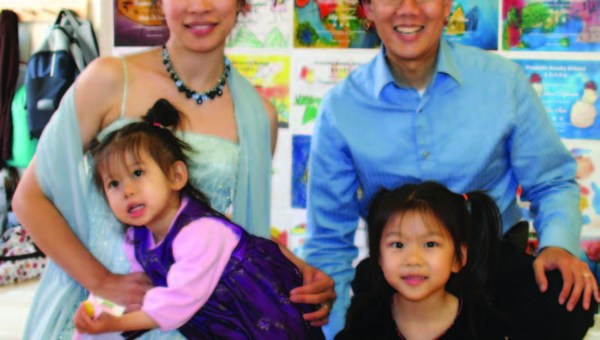
“I wanted to send my daughter to a preschool that would nurture and encourage her curiosity and incorporate Mandarin language,” says Wendy, who is mother to two girls, ages six and three. “My husband and I were unable to find a preschool that fit the bill that didn’t also have a seemingly endless wait list. Instead of giving up on our dream or moving to another city, we decided to do something about it.” With the support and elbow grease of a group of founding parents, Presidio Knolls School opened in February 2008. A month later, our family became part of its community too.
At MHC, Wendy says she learned that it’s “important to take it upon yourself to make a difference, rather than wait passively for change to happen.” Wendy now concentrates on fundraising for the school, which serves two- through five-year-old children, and expanding in a new site this year.
—By Olivia J. Boler ’93
For more information on Presidio Knolls School, go to www.presidioknolls.org.