


Mona Bernstein Dukess ’57: The Color of Water
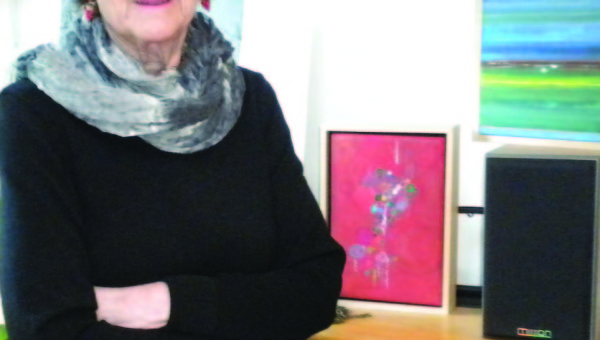
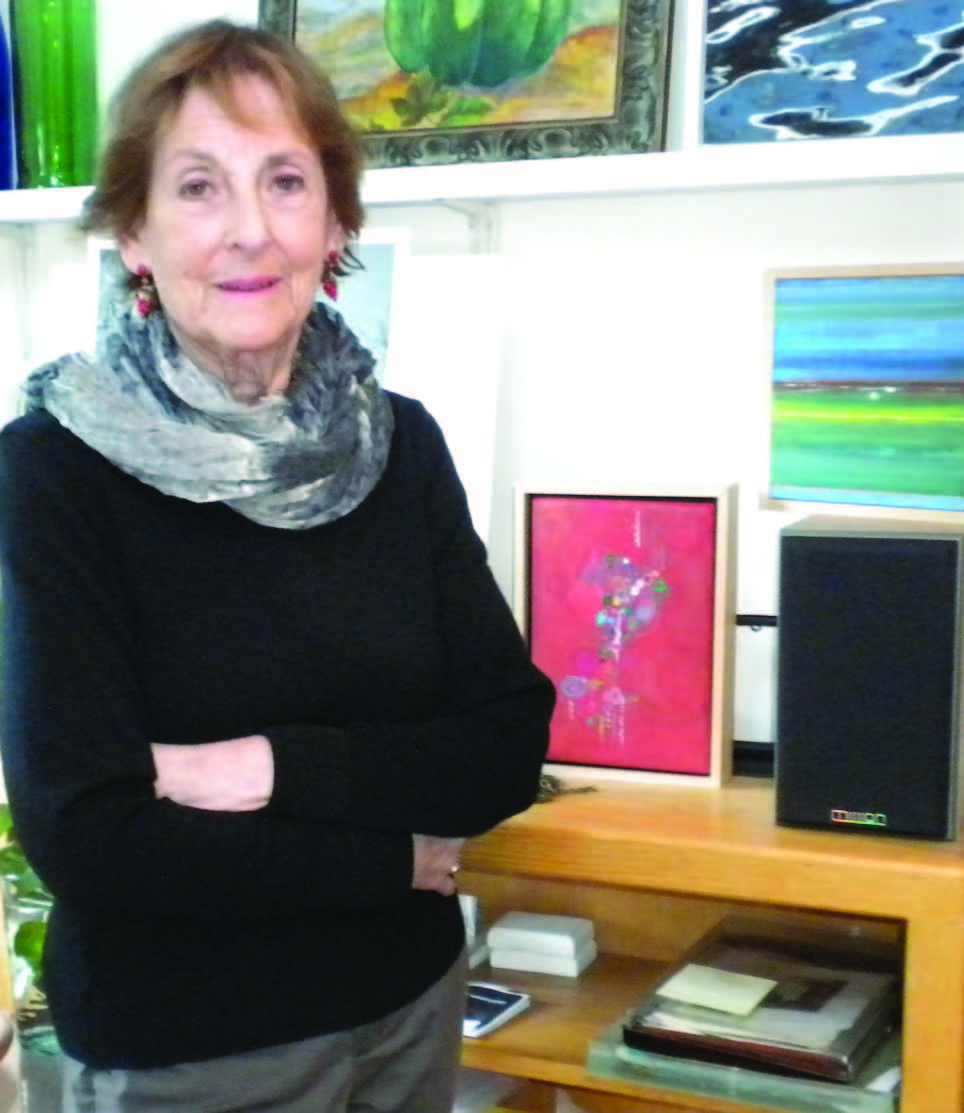 As abstract as the art of Mona Bernstein Dukess ’57 can be, when looking at it you have the sensation of seeing something familiar. A painting’s bold shock of blue, the varying intensity of shade, a horizontal brushstroke’s suggestion of movement—the viewer is tempted to dip a toe into the sea of color. This artist has managed to transform her watery inspiration into a both palpable beauty and timeless mystery.
Mona’s most provocative images are created with her own handmade paper, a time-consuming and waterlogged procedure that she describes as “a messy, wonderful process.” Beginning in early 1980s, at a time when artists rarely attempted handmade paper, Mona mixed pigment directly into the wet paper mixture, so that color was never brushed onto a dried sheet of paper. The handmade paper acts as both canvas and paint, resulting in a wholly integrated and truly one-of-a-kind piece.
After children and a graduate degree in education in the 1970s, Mona returned to her childhood love of art. Renting a studio near her home in Larchmont, New York, she began her journey into abstraction with her depiction of hard-edged shapes. Mona later found herself exploring a more biomorphic, or “feminine,” vocabulary of circles and ovals.
The surroundings of her seasonal home in Cape Cod, Massachusetts, inspired her move from a representational to an abstract sensibility. Marshes, ocean, seaweed, shells, patterns in beach sand—all these images have been the springboard for paintings and prints, with water as the most compelling force. Digital photography has been Mona’s recent mode of expression; she maintains the sense of abstraction by cropping images.
Mona consistently exhibits her work in the Northeast, and draws support from the artists’ colonies of Cape Cod—a community that, Mona says, “gives me the nourishment to keep going, and I love it. It’s me…totally.”—K.H.
Lois McHerron Anderson ’80 Reinvented Herself Re-Creating Garments
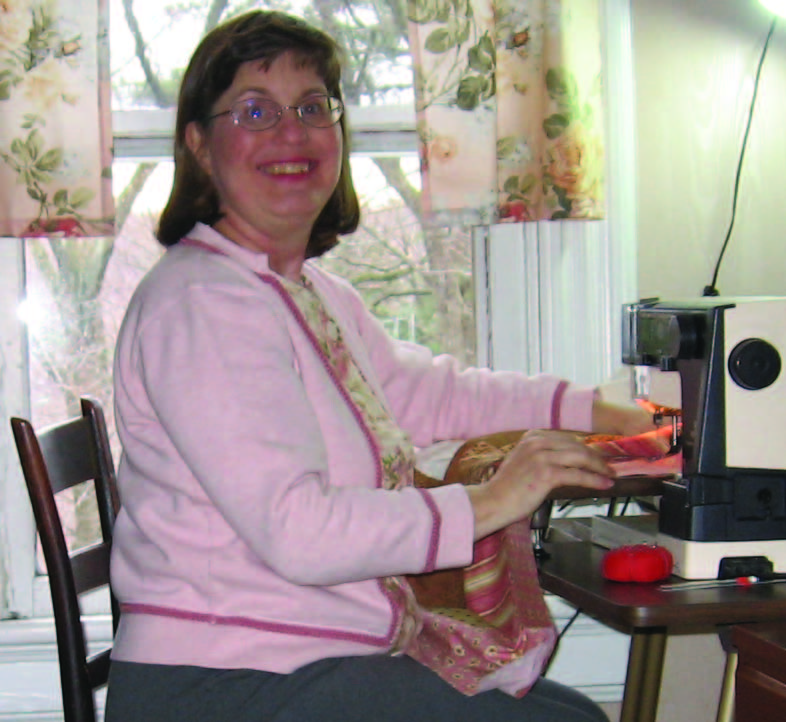
“Green” dressmaker Lois McHerron Anderson in the room where she creates new garments (including the top she’s wearing) from older ones.
After surgery to correct a back problem was only partly successful, Lois McHerron Anderson was forced to end a twelve-year scientific career as an environmental consultant. Unable to do many kinds of work for physical reasons, she searched for a way to feel productive and contribute to society.
The answer was to use a skill she already had: needlework. Her mother had been a professional dressmaker, and Lois has been sewing since she was in junior high school.
Lois started Magnolia Hill Re-Creations in 2010, and is skilled in clothing construction and design, quilting, and embroidery. Because she specializes in fashioning new items out of used fabric and embellishing and altering old garments, it’s a “green” business that joins her passion for needlecrafts and environmental concerns.
She can turn a turtleneck into a V-neck, a tablecloth into a striking skirt, fabric scraps into doll clothes, and a T-shirt collection into a quilt. She does standard home décor sewing too—duvet covers, pillows, chair cushions, and such—as well as new custom clothing, and many projects yield one-of-a-kind artworks.
For a client who’d lost both parents, Lois made a fancy lace handkerchief of the client’s mother’s into the centerpiece of a quilted table runner. She helped a widow keep her late husband’s memory close to her, in the form of a pillow made from his favorite sweaters.
“Every project presents unique problems to solve, and that keeps me sharp and thinking creatively,” Lois says. Just for the technical challenge of it, she once designed and made a blouse and skirt that wasted not a single snippet of fabric.
Lois’s sewing room is full nearly to bursting with fabric new and old, antique lace, embroidery floss, and other sewing paraphernalia. And business is booming from word of mouth alone.
She’s grateful to have reinvented herself as a dressmaker/designer. “Sewing is adaptable to my disability,” she explains, and requires both sides of her brain—scientific precision and creativity—to work together seamlessly.—E.H.W.
Diane Souder ’75 It’s Mountain Day…All Year Long
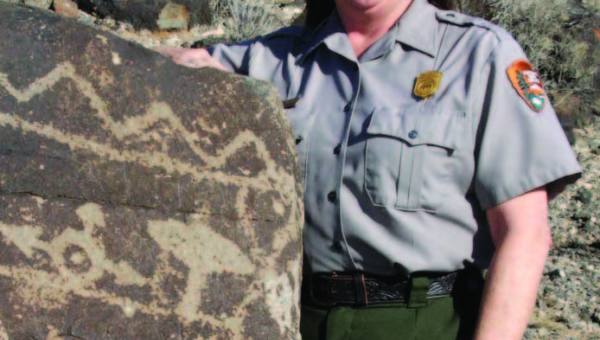
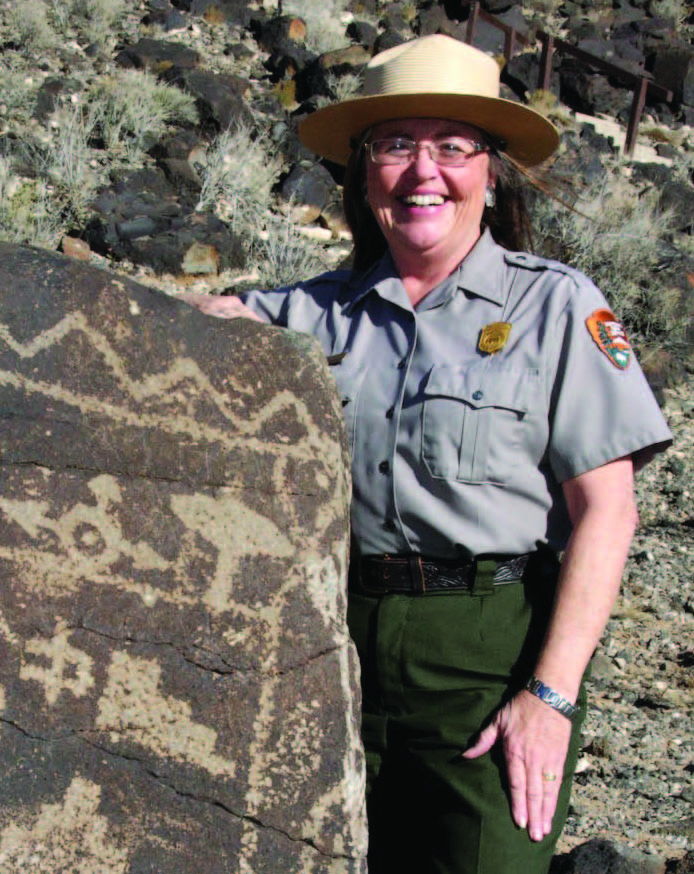 Diane Souder ’75 once hoped to solve one of America’s most vexing problems: poverty. This national park ranger now says she’ll settle for getting every child in the Albuquerque, New Mexico, school district to visit Petroglyph National Monument before they graduate high school.
Chief of interpretation and outreach at the monument, which contains an estimated 25,000 rock carvings reflecting the spirit life of the indigenous tribes who created them, Souder’s work incorporates her interests in urban planning, resource management, and the outdoors. The site encompasses more than 7,000 acres within Albuquerque city limits and is the only one of 397 national park units jointly managed by the National Park Service and a city. Some 150,000 people visit every year.
An urban studies major at MHC, she received a master’s degree in urban planning from the University of Michigan and eventually landed in the Southwest as a VISTA volunteer, working with Indian tribes on land-use issues. After the federal Heritage Conservation and Recreation Service, where she worked, was absorbed into the National Park Service, she was asked to help plan the petroglyph monument to protect and interpret the thousand-year-old carvings and make them accessible to everyone.
The federal government didn’t own any of the land or have money in the budget for the project when she started. And together with the park superintendent, Souder worked for four years to draft a detailed plan for the monument that was finally established in 1990.
Twenty people now work at the site, but Souder’s responsibilities still include a little bit of everything, from opening the visitor center in the morning to writing educational video scripts to leading a walking tour through the park. She happily notes that she wears hiking boots to work every day to appreciate the offerings of the often-sublime geography.
“It’s Mountain Day every day,” Souder says of her job.—M.H.B.
Susan Throckmorton ’65: The Art of Cutting Paper
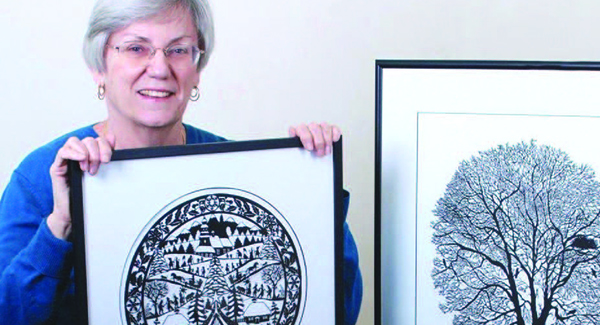
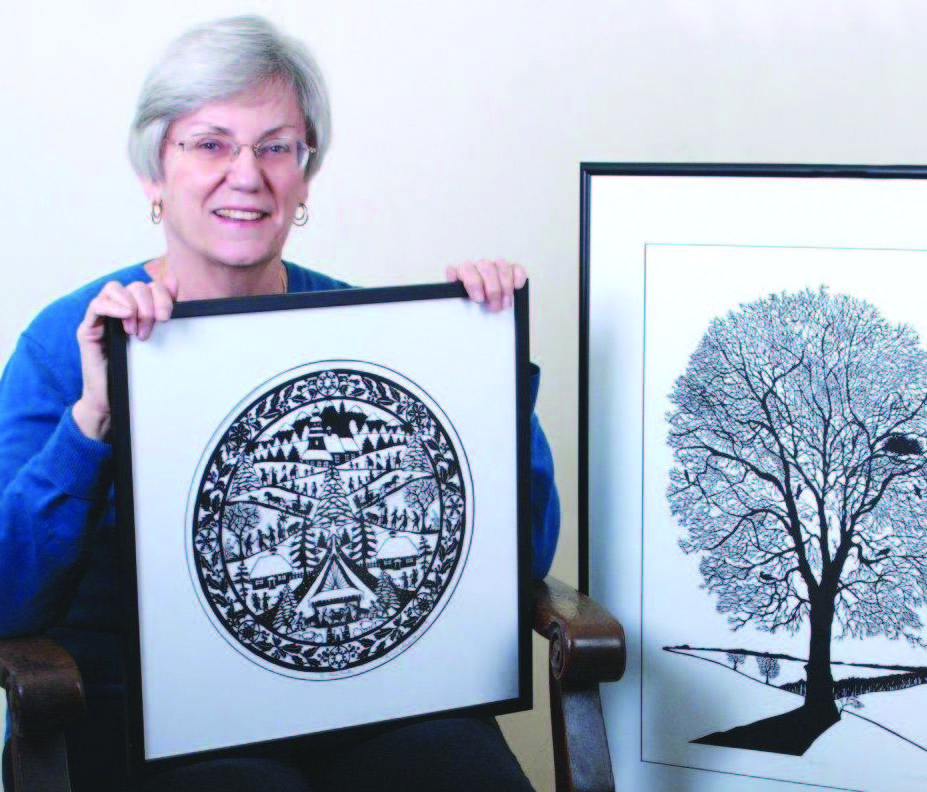 The intricate designs that illuminate Susan Throckmorton’s papercuttings delight the eyes, but make your hands hurt just looking at them. There are dense forests, slender cactus needles, fruit and flower montages, and birds, lots and lots of birds.
Papercutting is an ancient art that is still celebrated in various forms by folk cultures around the world and involves creating elaborate scenes and motifs on paper using a pair of very small, very sharp scissors. Picture the paper snowflakes you cut out in grade school—on steroids.
While many paper cutters work in color, Sue works primarily with paper that is black on one side and white on the other. She sketches her intended drawing on the white side and then begins to cut, starting usually from the inside and working out. The black side of the paper is ultimately set, face up, on a sheet of white paper.
“I always have been interested in folk culture,” she explains from her apartment in Warsaw. Over the course of a teaching career that took her to India, the former Yugoslavia, Finland, Indonesia, and finally Poland, she amassed a large collection of folk sculpture, carpets, textiles, and naïf paintings.
She got serious about papercuttings when she made one as a gift for friends who were leaving the country, and then made some to illustrate a book of animal poems for children, The Humply Rumply Beast, which she wrote.
Sue caught the eye of art historians in 2000 when she exhibited her work in Krakow, Poland, and has subsequently exhibited in Holland, the US, Germany, and China. She is an active member of the Guild of American Papercutters.
Sue is currently finishing another children’s book illustrated with her papercuttings but also does lots of commission work for clients—including classmate Bonnie Ulrich. Check out Sue’s work at www.papercuttings.waw.pl.
—By Mieke Bomann
This article appeared in the spring 2012 issue of the Alumnae Quarterly.
Off the Shelf: Spring 2012
Nonfiction
Lexington Books
In the Words of Women: The Revolutionary War and the Birth of the Nation, 1765–1799
By Loiuse V. North, Janet M. Wedge, and Landa M. Freeman
Bringing together the letters, diaries, pamphlets, and plays of women who lived during the American Revolution, In the Words of Women explores the trials of lesser- known figures of the period who boycotted, fought, nursed, ran the farms, and spied with little recognition. Their writings help readers understand the role women played in the tumultuous years of America’s founding.
Landa M. Freeman FP’95 is a visiting lecturer at numerous historical societies and university groups. She is the coauthor of Selected Letters of John and Sarah Livingston Jay.

Peter Pauper Press
The Ultimate Divorce Organizer: The Complete, Interactive Guide to Achieving the Best Legal, Financial, and Personal Divorce
By Laura Campbell, with Lili Vasileff
Divorce is difficult for any couple, both emotionally and financially. This guide offers readers worksheets, exercises, and strategies to help manage their assets and manage a life in transition. When the current recession lifts, more couples are expected to divorce. This organizer is a comprehensive resource to help get them through it.
Lili Vasileff ’77 is a divorce financial expert and the founder of Divorce and Money Matters, a financial planning practice.
CRC Press
Origami 5: Fifth International Meeting of Origami Science, Mathematics, and Education
The fifth book of its kind, Origami 5 explores the connections between origami and science, education, math, and other related fields. The book begins with the history of origami art and design. What follows is a guide to the relationship between origami folding and engineering and technology, as well as the mathematical underpinnings of origami.
Patsy Wang-Iverson ’68 is director of special projects for the Gabriella and Paul Rosenbaum Foundation. She is the editor of Building Our Understanding of Lesson Study.
Arcade Publishing
A Field Guide to Demons, Vampires, Fallen Angels, and Other Subversive Spirits
By Carol K. Mack and Dinah Mack
In this updated edition of their field guide, Carol K. Mack and her daughter Dinah Mack bring to life the fascinating— and sometimes horrific—creatures found in myth and legend. The book includes more than ninety profiles of ghouls and zombies, werewolves and bogeys. Learn about fairies in Sweden, man-eating vampires in Canada, and lots more in this deeply researched book.
Carol Klein Mack ’60 is an author and playwright. Her plays include SEVEN, The Visitor, and Writing on the Wall.
Harvard University Press
Galileo’s Muse: Renaissance Mathematics and the Arts
By Mark A. Peterson
Peterson’s new book is not only a biography of Galileo but also an argument for the importance of Renaissance art in the birth of modern scientific thought. Peterson suggests that it was Nonfiction36 w w w. a l um na e . m t holyok e . e du the interplay of mathematics in the Renaissance arts— perspective in painting and tuning in music—rather than the ideas of Renaissance science that became the basis for modern science.
Mark A. Peterson is Professor of Physics and Mathematics on the Alumnae Foundation and chair of the physics department at MHC.
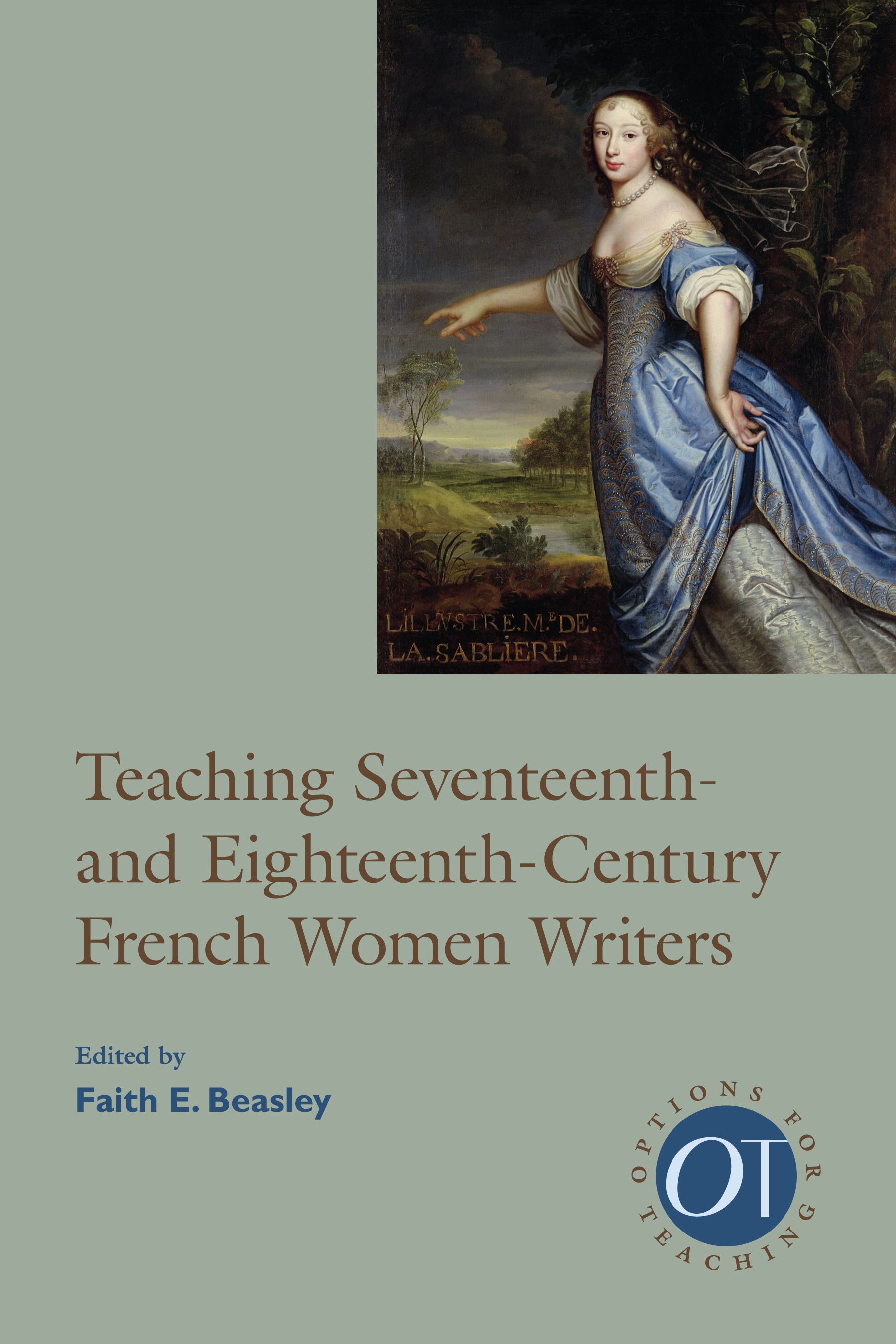
Modern Language Association
Teaching Seventeenth-and Eighteenth-Century French Women Writers
By Faith E. Beasley
During the seventeenth and eighteenth centuries, the writers of France’s “grand siècle” and the Enlightenment produced great works of satire, drama, political commentary, and poetry. Beasley’s latest work helps teachers in contemporary classrooms find ways to recreate the dialogues that occurred among these extraordinary French women as well as among the best-known male writers of the time.
Faith Beasley ’80 is professor of French at Dartmouth College. She is the author of Salons, History, and the Creation of 17th-Century France.
Poetry
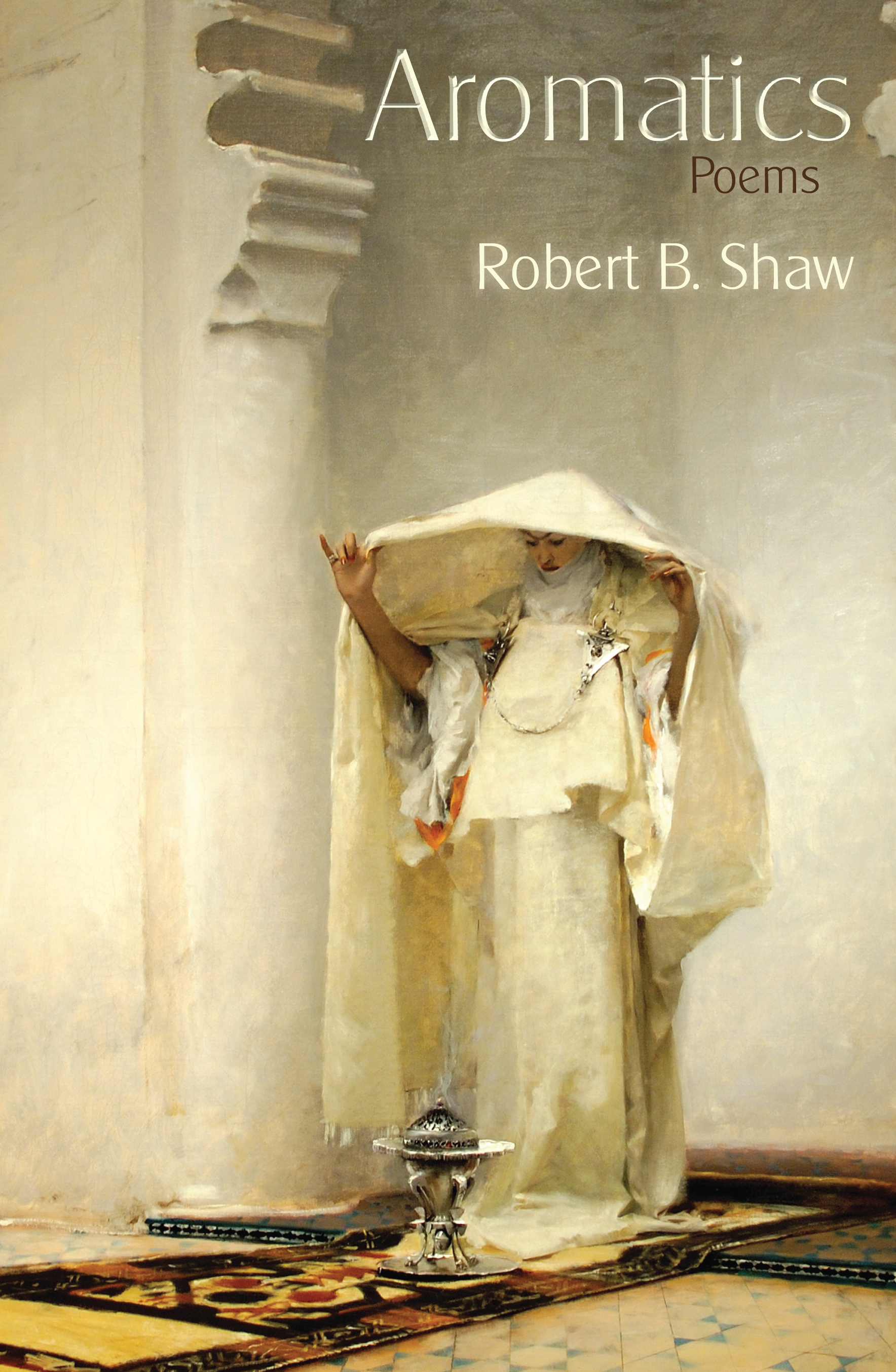
Pinyon Publishing
Aromatics
By Robert Shaw
With his latest book of poetry, Robert Shaw examines scents and the memories attached to them—some bitter, some sweet. The structural patterns of Shaw’s poems are varied, and many of his subjects are thoughtful reflections of daily concerns. Aromatics follows Solving for X, which won the notable Hollis Summers Prize.
Robert Shaw is Emily Dickinson Professor of English at Mount Holyoke. Aromatics is his sixth book of poetry
Fiction
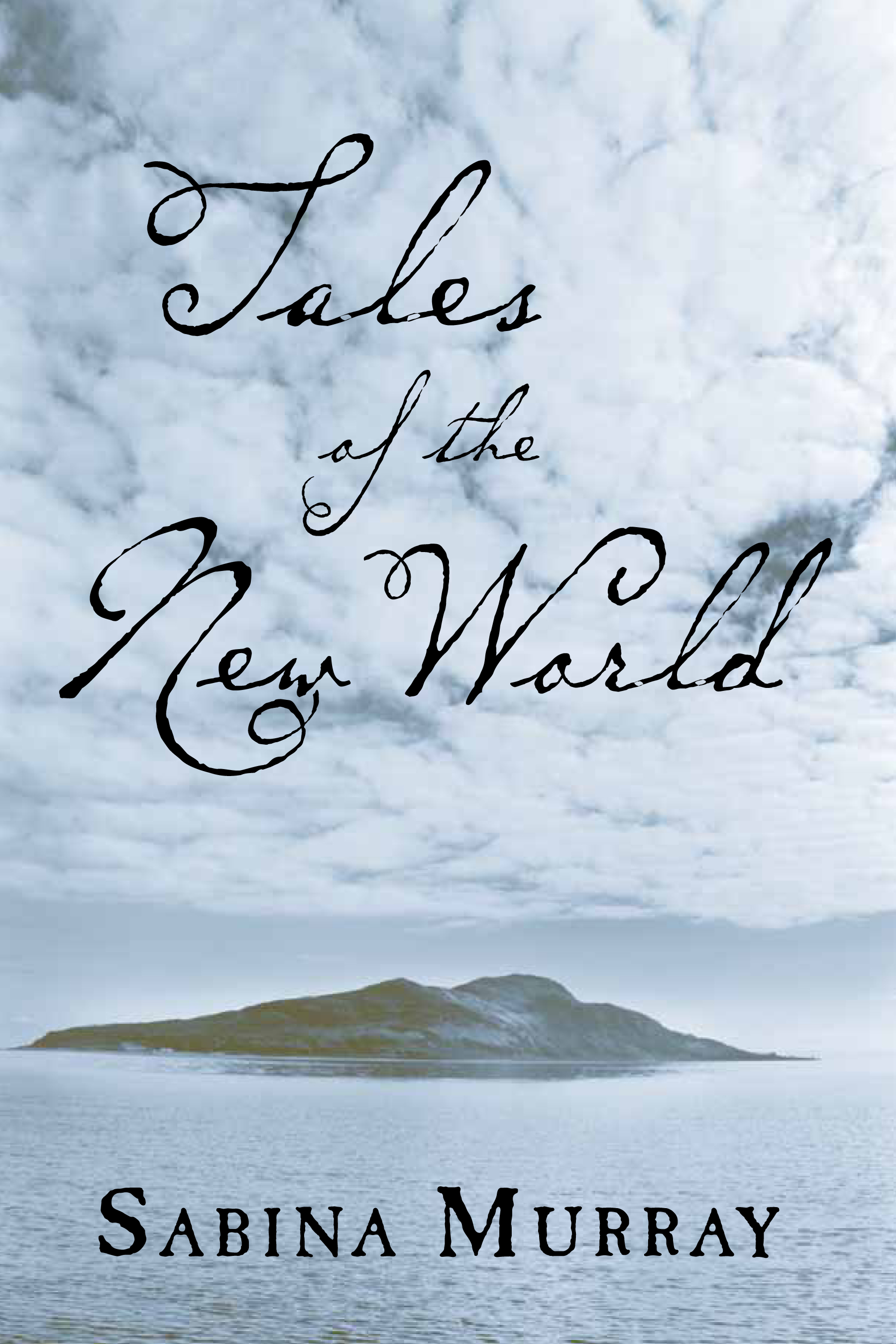
Black Cat
Tales of the New World
By Sabrina Murray
Sabina Murray’s latest collection of short stories focuses on global exploration, for better or worse. Her cast of characters spans hundreds of years—from Magellan to Jim Jones—and includes less-known names whose stories are no less compelling.
Sabina Murray ’89 is the author of one previous short-story collection, The Caprices, and several novels. Her previous work won her the Pen/Faulkner Award. She teaches creative writing at the University of Massachusetts–Amherst.
Music
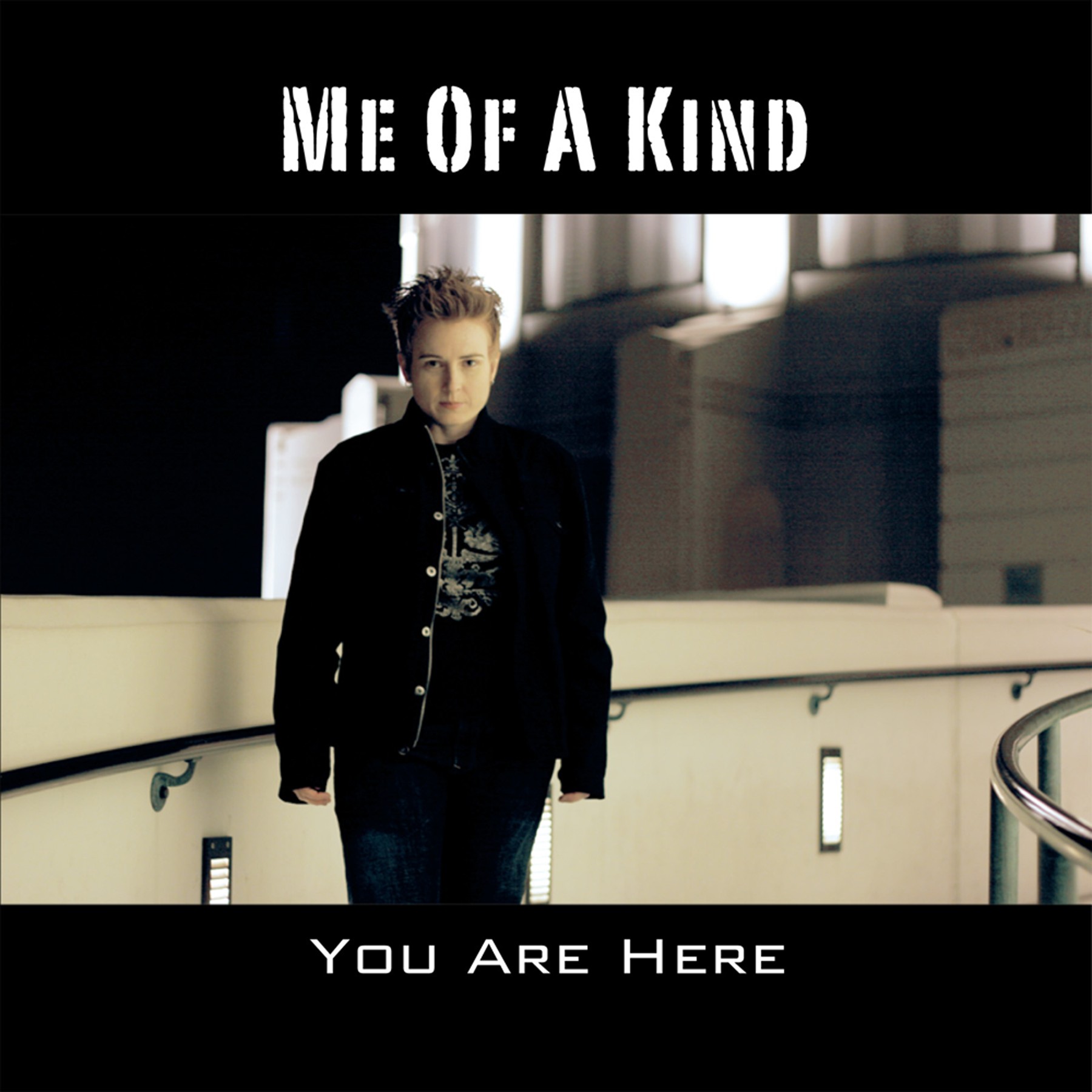
Rampage Productions
You Are Here
By Me of a Kind
Me of a Kind is a three-member, alternative rock band founded by Jen Schwartz, a singer-songwriter and multi-instrumentalist. Schwartz crafted the band’s debut album almost single-handedly. Her lyrical subjects revolve around her experiences as a queer woman and combine personal storytelling with lush arrangements and intricate rhythms.
Jen Schwartz ’94 was formerly the drummer for the band Tribe 8. She lives in San Francisco.
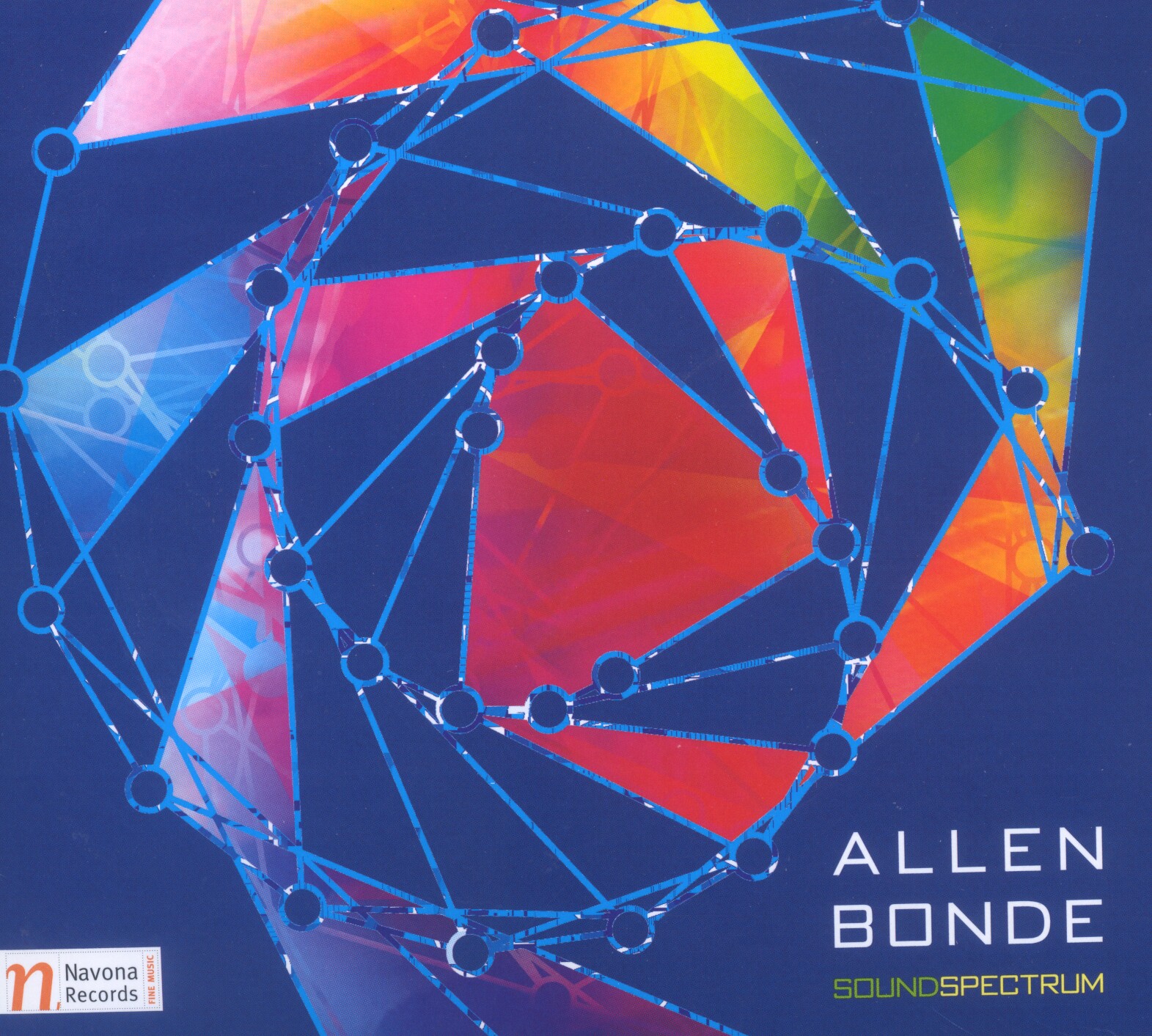
Navona Records
Sound Spectrum
By Allen Bone
Featuring works for piano, soprano, and orchestra, composer and pianist Allen Bonde’s album was made with contributing performances by his wife, Maria, and daughter Mara Bonde Ricker ’91, a soprano whose talent is in demand all over the world. Bonde found inspiration in the works of Shakespeare, the poetry of Mary Jo Salter, and even the rose window of Abbey Chapel.
Allen Bonde is professor emeritus of music at MHC. His career at Mount Holyoke spanned almost forty years.
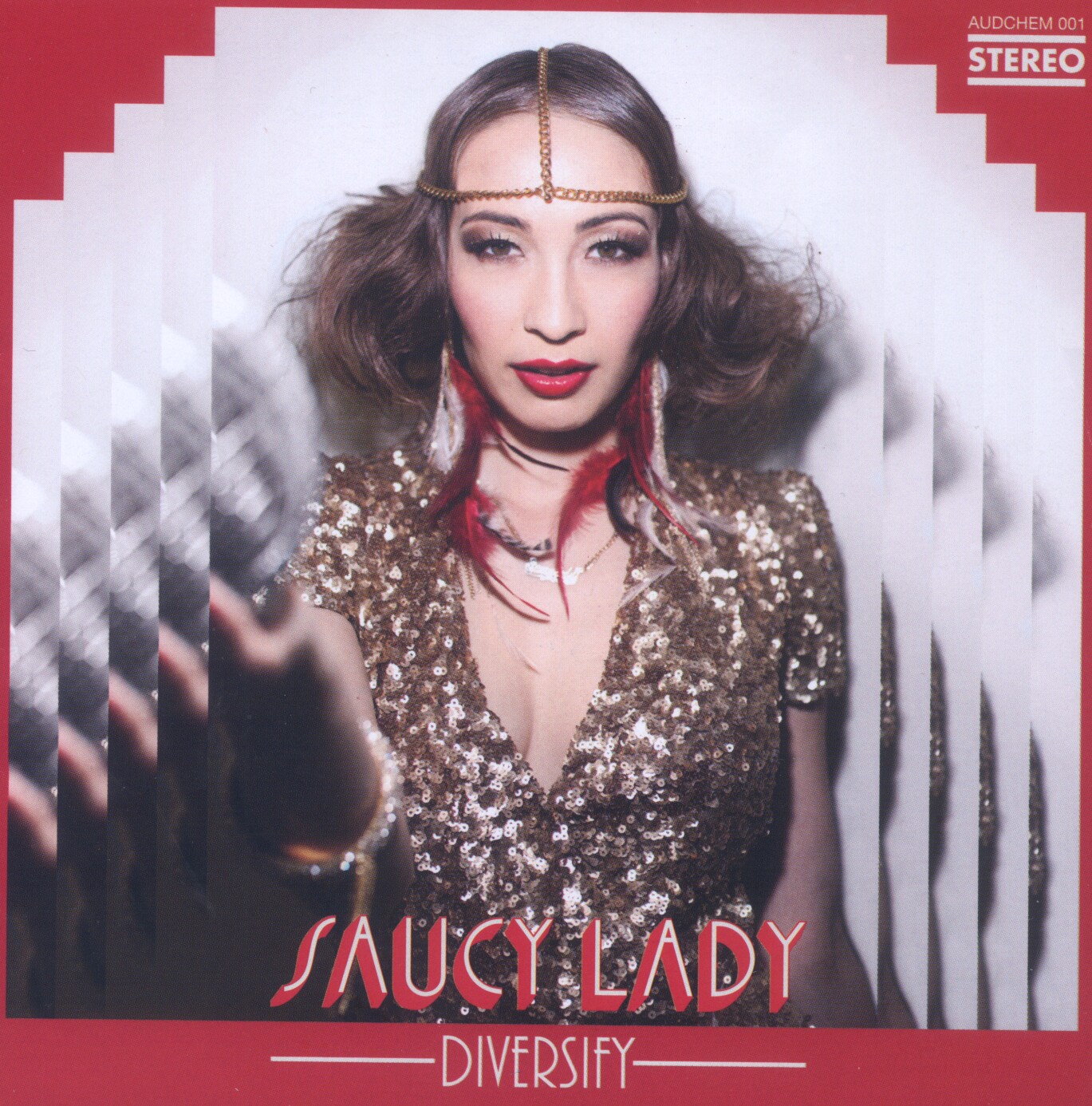 Diversify
By Saucy Lady
Saucy Lady, a.k.a. disk jockey and singer-songwriter Noe Carmichael, has released her debut vocal album. It is a mix of disco, hip-hop, house, and Afro-beat. In support of the new album, Carmichael has also released her first music video, “City Lights.”
Noe Carmichael ’00, performing under the name Saucy Lady, balances her music career with a full-time job at an e-commerce company. She is also collaborating with other Boston-area disk jockeys to start an entertainment booking agency
Self-published Books
iUniverse Publishing
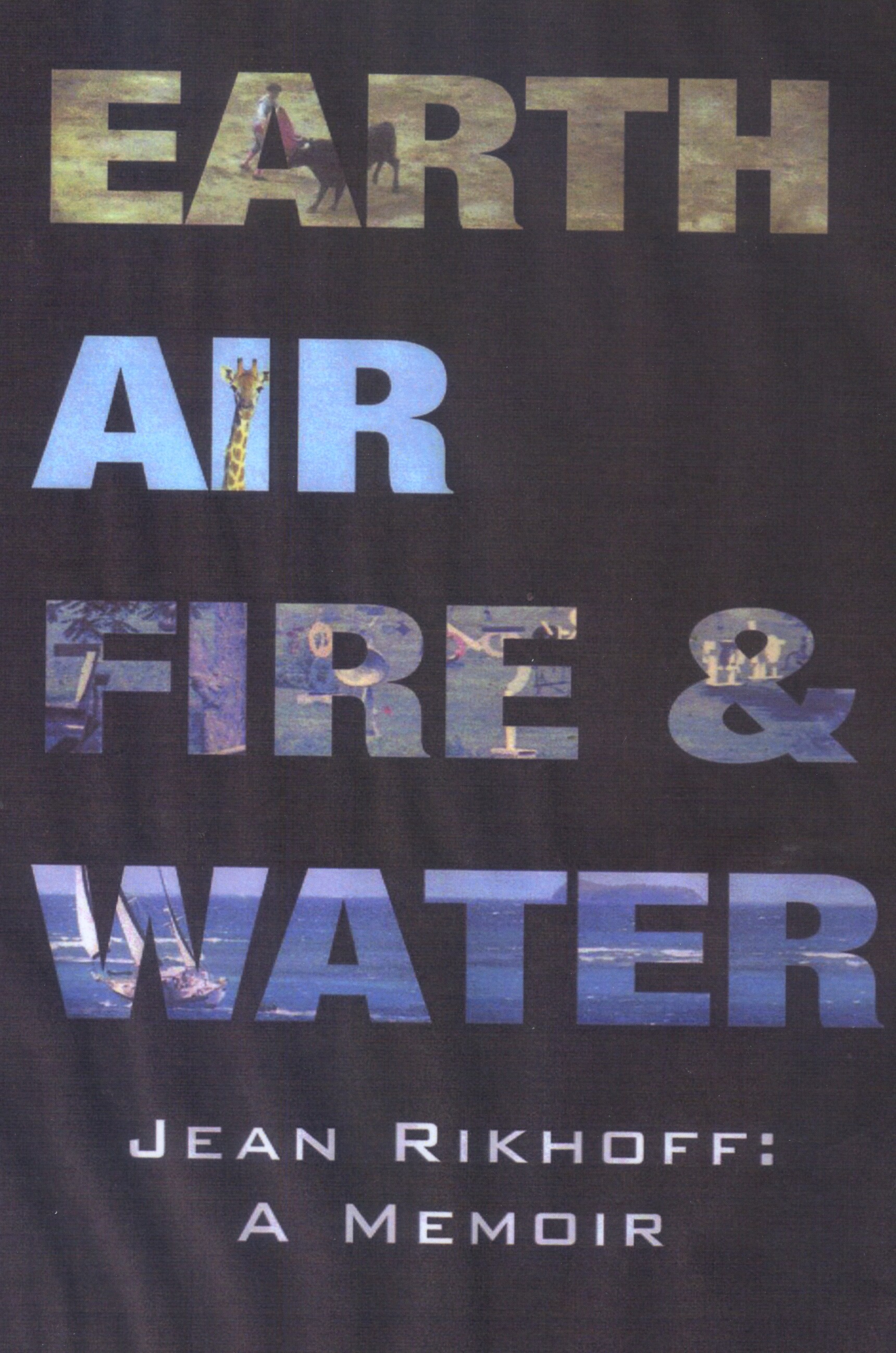
Earth, Air, Fire, and Water
By Jean Rikhoff
From all the unusual adventures she has experienced throughout her life, Jean Rikhoff has selected four of those most important to her and collected them into her latest book, a memoir. In “Water,” she writes about her trips from England to Spain via numerous hard-to-maneuver waterways; in “Earth,” she covers her years in Franco’s Spain; “Fire” recounts her friendship with the sculptor David Smith; and “Air” concerns a trip she took to Africa.
Jean Rikhoff ’48 is the author of seven novels and two young-adult biographies and is the founder of the Quixote literary review.
Boom-Books
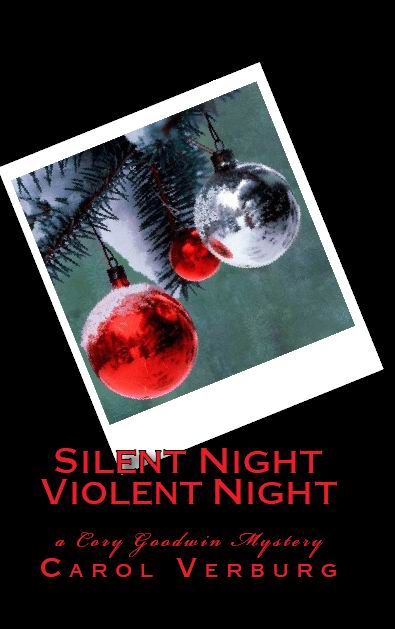
Silent Night, Violent Night: A Cory Goodwin Mystery
By Carol Verburg
Verburg’s latest mystery centers on professional intrigue, possible love affairs, and murder. Snowed in at a Christmas party where one of the guests may or may not be the murderer, Cory Goodwin must determine who is guilty, whom she can trust, and how to keep herself safe.
Carol Verburg ’70 is the author of several books, most recently Edward Gorey Plays Cape Cod: Puppets, People, Places, & Plots. She is best known as an award-winning playwright and theater director.
Muse Publishing, USA
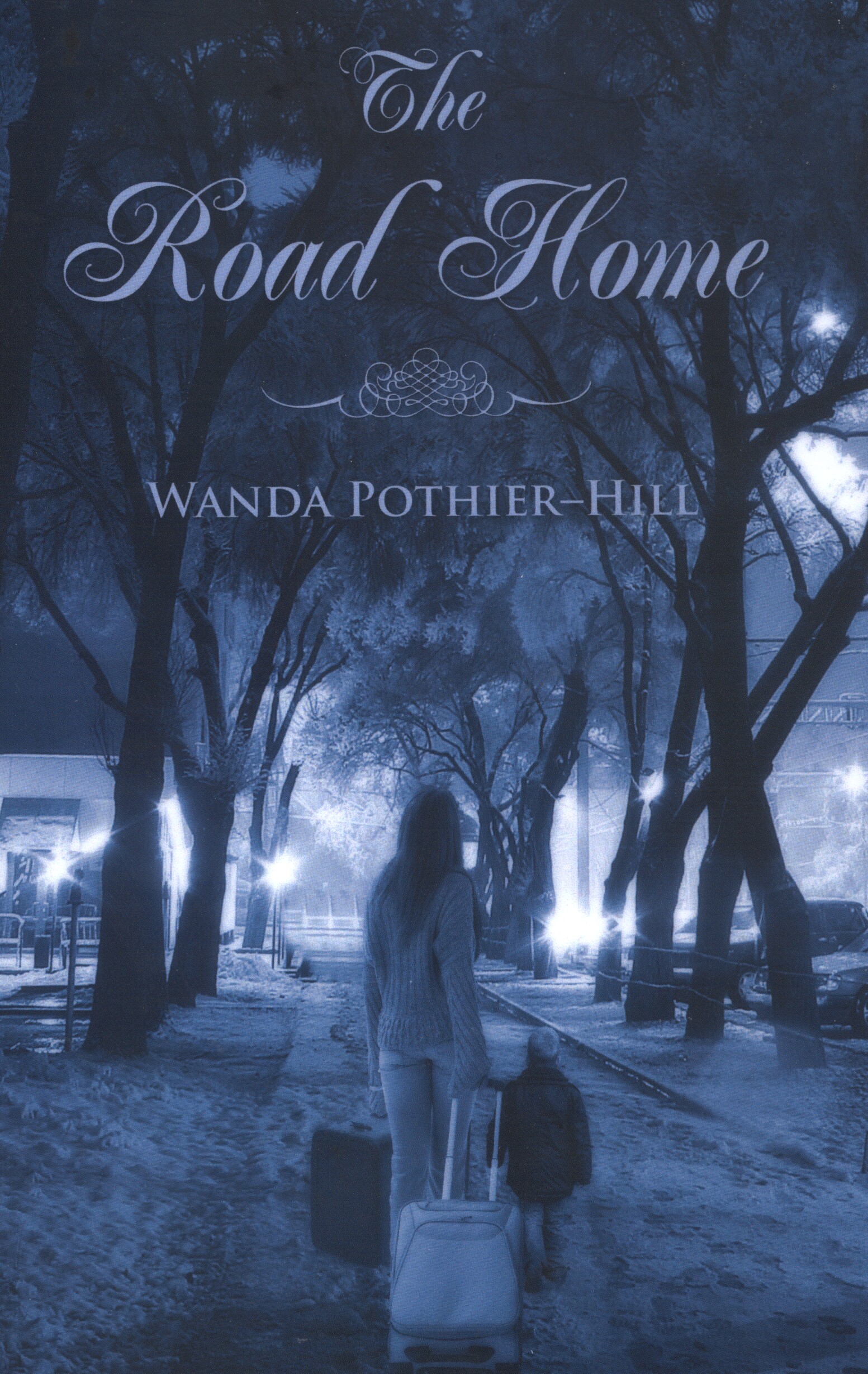
The Road Home
By Wanda Pothier-Hill
Karen’s life is not all she dreamed it would be. Raised in a wealthy family, she was the life of the party and engaged to marry the perfect man. After an argument with her fiancé, though, everything changes. Years later, Karen returns home a single mother with a young son, ready to confront her past.
Wanda Pothier-Hill FP ’04 received her MFA in creative writing from Goddard College. She has been an adjunct professor at Mount Wachusett Community College. The Road Home is her first novel.
This article appeared in the spring 2012 issue of the Alumnae Quarterly.