



Alum Blog: “Yankee Kitchen Ninja” Julianne Trabucchi Puckett ’91
 Julianne Trabucchi Puckett ’91 is known to her faithful followers as the Yankee Kitchen Ninja, or “the Ninj” for short. This title might have something to do with her knife skills in the kitchen and the unorthodox recipes she features on her blog Adventures of the Yankee Kitchen Ninja.
With Ninja-like precision, she spies recipes in her stash of cooking magazines and on Pinterest, deftly adapts them to her palette, and takes a knife to the ingredients before pounding, stirring, and pureeing them into a yummy masterpiece. When her dish is finally feast-worthy, the Ninj snaps a pic and writes about the recipe with vicious wit.
Don’t read Kitchen Ninja if you are hungry, it is torture. The Ninja’s recipes are sometimes adventurous—chocolate ice cream with candied bacon bits—and sometimes simple, but they always make whatever ingredients she has combined look exactly like what you wanted for lunch. One useful aspect of the blog is the “CSA share ninja rescue,” where all those crazy looking things that come in your CSA (community-supported agriculture) share box are unmasked as the nutritious and delicious potential pickles, salads, and soups that they are.
She operates out of her ten-acre “farmette” in Vermont and uses seasonal ingredients. Recipes like banana breakfast hummus, green tomato cake, and chocolate chip potato chip cookies are common on this blog, perfect for fearless foodies. The Kitchen Ninja’s highest recipe criteria are “wicked easy and wicked good.”
The Ninj explains the aim of her blog is to have a conversation with readers, “peppered with smart-assed humor, step-by-step photos, and probably too many parenthetical asides.” This recipe won her a 2012 Weblog Award (a “Bloggie”) for the “best-kept-secret blog,” and Vermont Life magazine recently recruited her to write a twice-a-month guest blog post for their new website.
—By Zanna K. McKay ’13 and Olivia Lammel ’14

The Alumnae Influence
Watch a video about how alumnae from around the world influence young women to attend Mount Holyoke College.

Strands of Time
Unraveling Knitting’s Enduring Appeal at MHC
Purl Soho, owned by Joelle Hoverson ’89
Photo courtesy Open Road Integrated Media
Often I’ve slipped back in memory to an anthropology class, Marriage and the Family, in the fall of my junior year. I sit at the end of the second row, knitting maroon wool into a sweater for my boyfriend, while up front Mr. Lobb explains how anthropologists compare cultures. In this course and many others, we are allowed, even encouraged, to knit. Learning, the theory goes, involves listening and thinking. Class discussion will illuminate material we’ve already read, while we consider concepts and, occasionally, when an idea clicks, jot something down. Today we’re covering where couples live after marriage. Matrilocal—I try to imagine newlyweds fitting in my mother’s house. Or—patrilocal—joining my future husband’s father’s family. I deliberately don’t picture my boyfriend, known to all as Turtle. I’m happy we’ve lasted six months, but don’t want pressure. And must I really get married to live with someone neolocally, in a new place? In 1970, many of us question the roles and rules of marriage and family, though we have no idea how contested they will be, for how long. I twist in my seat and scan the room. Many knit, some crochet. One girl is knotting a macramé project fastened to the far wall, while in the back another has set up a smallish loom. Someone could study us, I think, as a matriarchal tribe whose founder’s grave is in the center of our village. I make a note.
Did that thought fix the moment in my mind forever? My grandmother taught me to knit. When I got to South Hadley, I visited The Yarn Shop (“The most beautiful yarns from all over the world,” proclaimed their ad in my freshman handbook), where I bought a skein from which I whipped up the first of many watch caps for my relatives. Was it desire to make a Christmas gift for Turtle or knitterly ambition that led me to attempt my first sweater? Wanting to try working with two colors, I adapted a men’s ski pullover with snowflakes up the sleeves. Only if you looked closely could you tell (maybe) that my white “snowflakes” were turtles.
Turtle and I broke up in our senior year. The sweater had nothing to do with it.
Only much later did I hear of the “boyfriend sweater curse,” the notion that making a sweater might mean doom. Or could it just be that a certain percentage of sweater-level relationships won’t survive? Before the break-up, I’d begun an afghan for my mother. Its lace pattern was complicated, and the color she chose, “antique gold,” seemed to me dull mustard. Before finishing it, I was in graduate school where no one knitted in class, ever. I discovered I’d been in a bubble at Mount Holyoke. Elsewhere, an un-grandmotherly woman who knitted in public was the object of suspicion. Men mentioned Madame Defarge. Interest in knitting had declined and crocheting pretty much disappeared. In private, over time, I made myself a cotton shell, a mohair shawl, a Perry Ellis sweater with pleated ’80s shoulders. On trips, I’d search out a city’s only yarn shop, and find other women buying bags-ful, like the last addicts of an out-of-fashion drug. Other Mount Holyoke graduates tell me knitting was out of the question in science classes. Some mention the embarrassing clang of a dropped metal needle or being offended by people who called knitting sublimated sex, but many describe happily finishing first scarves and learning stitches from friends. Laurie Stein-Stapleford ’74 began knitting because a teacher came close to requiring it, saying, “You can’t listen if you’re busy writing.” Jan Baldini Bohn ’72 remembers a senior sociology seminar in which the professor knitted, expertly. There’s evidence this acceptance has a history. In a photo of 1949 English department lecture, students laugh and knit. The 1944 yearbook describes the afternoon hour when volunteers knitted for the military in the Mary Lyon Room, then adds, “But we are always doing knitting outside of hours, dropping our ball of yarn in classes, sacrificing the efficiency of both by trying to read and knit at the same time…” Llamarada 1942 says, “At the movies there was nothing like stretching your feet over the railing, knitting your sweater (providing it wasn’t cable-stitched) and watching Donald Duck or Charles Boyer.” Enthusiasm still bubbles in a 1917 New York Times article about war efforts at Mount Holyoke: “The girls are taking up courses in nursing and stenography and typewriting as a preparation for war work, and they knit all the time. It has now been forbidden at meal times.” Sixteen years after it left, the turtle sweater returned, along with its owner. Yes, Reader, I married him. But let me stick to the story of the sweater. It looked fine, not worn much, perhaps, but not discarded. When I first met my mother-in-law, she said she’d always thought a lot of love went into that pullover. Those patient turtles do testify to devotion, but they also remind me how I liked the process of listening and thinking while creating something with my hands. For knitting, too, what seemed an end was only hibernation. Needlecrafts came back in the ’90s, along with appreciation of almost-forgotten craftswomen’s mastery of geometry, color theory, and sculptural forms. Rebellion against manufactured sameness sparked a boom in crafting expressive garments, retro or avant-garde. Most fascinating to me has been the revolution in communal knitting, from “stitch-n-bitch” sessions in bars to guerrilla knitters’ projects that appear overnight in public spaces as protests or salutes. Knitting has been reconnected to education, including a new focus on teaching boys. Proponents of knitting programs in inner-city schools and prisons argue that use of fine motor skills helps with hyperactive restlessness, calms the mind, builds self-confidence, and leads to mastering other learning. Which isn’t so far, it seems, from where I started. After my mother’s death, as we sadly sorted through her things, my younger sister (Jerri Barrett ’83) said of course I must take what I had made. Today, in our (neolocal) home, the afghan, well-worn, is a patch of amber. I had no idea what would last, no idea how much I was stitching into memory.
—By Lynne Barrett ’72
This article appeared in the fall 2012 issue of the Alumnae Quarterly.

Joelle Hoverson ’89 in her modern craft emporium in
New York City, Purl Soho
Photo courtesy Open Road Integrated Media
Imagine an old-fashioned dry goods store with yarn, fabric, and notions visible through large, glass windows. If you update that image with pops of bright color, a hip sensibility, and lively online presence, you’ll have Purl Soho, a modern craft emporium opened in 2002 by Joelle Hoverson ’89. A politics major, Hoverson was also passionate about photography and painting. She earned two fine arts degrees and maintained a studio even while working as a senior style editor for Martha Stewart Living Omnimedia. Yet when Hoverson left her job to paint full-time, she found herself pulled in a surprising new direction. “I would be in my studio and realize that I would rather be knitting,” says Hoverson. “Instead of angst, I decided to give myself over to women’s work.” Hoverson admits she would have been happy knitting rectangles for the rest of her life. Then Chicago-based photo stylist Kelly McKaig, with whom she worked on a freelance project, “pushed” Hoverson to learn more about knitting technique. McKaig, who later collaborated on Hoverson’s highly regarded craft books, proved to be a catalyst. “As a stylist, I was constantly shopping. It was my job to be familiar with retail, to know where the cool boutiques were,” Hoverson says. “There were a couple of neighborhood knitting shops and when I got burned out on being a stylist, I thought, ‘Why don’t I open a shop that features beautiful, amazing materials?’” Purl opened in a tiny storefront in Manhattan’s Soho neighborhood. It took Hoverson eight months to plan, but it took customers only a nanosecond to empty the shelves. “Purl could not have opened at a more perfect time for knitting,” she says. “My goal was to create a destination store, and everyone who was a knitter came out of the woodwork. I ran out of everything. Even the manufacturers were unprepared.” Purl has grown in a decade. The successful online business is managed by Jennifer Hoverson Jahnke, her sister. Purl Patchwork, a fabric shop that grew out of Hoverson’s love of quilting, opened in 2006. Today, knitting and sewing supplies happily coexist in a larger space; the sisters have a third partner, Page Marchese Norman. And the creative team behind the craft blog The Purl Bee has made it a go-to destination for inspiration. “The overarching change is that people take craft seriously now,” says Hoverson. “Craft, something you can actually teach someone how to do, is now viewed as legitimate.” —By Avice Meehan ’77

Women in High Tech
Alums Cross One of the Last Big Gender Gaps

One manages a group of engineers who make terminals that scan bar codes. Another pulls together news of arts festivals from all over the world. A third can turn paper maps into digital ones. A fourth tests Xbox games before they go to market. They are all women in high tech—and their stories tell us as much about the evolution of our culture as they do about an industry that has changed the way we live. With the tap of a finger, we can now shop and com- pare prices, track our friends and play games with one another, do our banking, and read the news—anywhere, anytime. Some alums saw these changes coming and, early on, became part of the nascent industry that would create products and services the rest of us didn’t yet realize we wanted. Others joined later, bringing knowledge and skills from other fields. Here’s what we learned from talking to them.
A Foot in the Door
Some MHC alumnae are “technical women” who understand what’s under the hood. They are (or work with) engineers who write the code that makes digital products run. How a woman acquired IT skills depends, in part, on when she graduated. “There was no computer science major when I was at Mount Holyoke,” says seventy-year- old Carol Ochs Sigda ’63, software configuration manager in the enterprise mobile computing division of Motorola Solutions. “I was a math major. Computer programming was a new field when I graduated, and seemed like a challenging option.” Her first employer, Shell Oil, sent her to IBM school in 1963. “When I started my job at Motorola in 1997, I was still the only woman working with sixty-five male software engineers,” she says.
Jerri Barrett ’83, a biology major, taught herself programming when she worked at Rochester Telephone. “In the late eighties, telephone companies were instrumental in a lot of things that made high tech possible.” Assigned to make sense of a new voicemail system, she recalls, “I sat down with three enormous technical binders and figured out how to set it up.” In contrast, when Ying Wang ’96 was at MHC, there was a computer center on campus. Not only was it possible to major in computer science, but companies were actively recruiting interns from MHC. “Microsoft, a rising star twenty years ago, had special women’s scholarships,” explains Wang, who has worked her way up to a senior position at the company, where she currently “makes all the product decisions for [search engine] Bing in China.”
“I took several programming classes in high school,” says Alyssa Bennett ’07, “and there were plenty of girls in math and science but not in computer science.”
For all the progress technical women have made, however, it’s still not a level playing field.

Alyssa M. Bennett ’07 works for Microsoft, testing websites related to the Xbox Marketplace.
Photo by Kanita Rauniyar
Of students who took the advanced placement computer science test in 2011, 80 percent were boys. And while women account for 56 percent of all professional workers in the United States, they hold only a quarter of the IT jobs and 17 percent of technical jobs at start-ups. Only 7 percent are engineers. (By comparison, a mere 7 percent of lawyers were women in 1972, when Title IX was passed. Today, 47 percent are.)
Changing Course
One doesn’t have to be a “technical woman” to be a woman in tech. Putting out an online product or service, explains Beth Mulligan Dunn ’93, also requires writers, graphic designers, sales people, and marketing mavens who have the insight to understand end-users’ needs and the ability to make the technology accessible. “I’m in charge of making sure that every word you see on the computer screen when you use our software is clear, helpful, and to the point, as well as grammatically correct,” says Dunn, a UX (user experience) writer at HubSpot, which sells online marketing tools to businesses. She initially worked in the nonprofit sector, doing PR for a regional theatre. She experimented with social media tools such as Facebook and Twitter to develop relationships with theatre patrons, and, through her blog—bethdunn.com—began to connect with others who understood the online marketplace. Granted, Dunn was an early adopter. However, she and several other alums stress that the confidence, assertiveness, flexibility, and “fearlessness about any realm of inquiry” that come from having a liberal-arts education are invaluable in the tech field. “You can teach people how to code, [but that] becomes obsolete. If you teach someone to learn, they then are able to adapt to the fast world of the internet society.”
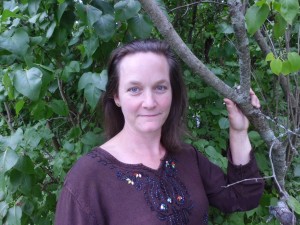
Ana Maria Harkins ’90 is chief operating officer of KadmusArts.
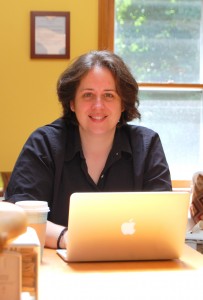
Beth Mulligan Dunn ’93, a user experience writer for HubSpot in Cambridge, Mass.
The word “serendipity” crops up often in conversation about switching to tech careers. Ana Maria Harkins ’90 spent five years at the internet start-up Geekcorps, which matched volunteers with companies that wanted to develop websites or specific kinds of software. “One day, I was providing a reference for someone, and the voice on the other end asked, ‘Are you looking for a job?’ He wanted a good manager who had been involved in a start-up and had lived and traveled in other countries.” Harkins, currently chief operating officer of KadmusArts, which tracks and aggregates news of performing arts festivals all over the world, was a perfect fit. Harkins explains that, although she’s in management, at small start-ups “everyone contributes to the website. I create and produce podcasts and manage our social networking presence.”
One doesn’t have to be a “technical woman” to be a woman in tech.
Heather Harde ’91, whom Fast Company in 2011 named one of “the most influential women in tech,” describes herself “as a generalist and strategist” who “grew into tech.” After Harvard Business School, she joined News Corp. “At the time, new tech was disrupting the old media. They’d pull me in to figure out new business strategies—should we be partnering? launching a new product line?” To keep informed, she began to read TechCrunch,the go-to blog for information about the industry. She eventually crossed paths with its founder Michael Arrington, who hired her to turn “the brand” into a profitable enterprise. “We worked out of his home with a few freelancers at first,” she recalls. Five years and fifty employees later, AOL purchased TechCrunch for a reported $40-50 million. Harde, forty-two, is now on a well-deserved “work sabbatical.”
Coming Back
Taking a break from work can be challenging in the fast-moving tech world. Alyssa Bennett, who set her sights on tech in high school, delayed her entry into the field to take a “gap year” and then help her family, taking office temp jobs in the interim. Three years later, it was difficult to find work. “Many IT jobs required years of programming, and my skills were out of date at that point,” she says. She found online want ads for entry-level testers who make sure that pro- grams function properly. “I thought, I could do that. However, all the staffing agencies pretty much said, ‘Your bachelor’s degree in computer science doesn’t mean anything. A person who took one software testing class at community college is better qualified.’” She was eventually offered a test associate contract. She says, “It paid very little, but I hoped it would help launch my career, and it did.”
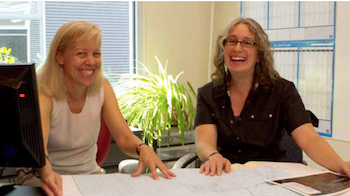
Cecily Herzig ’96 (right) and Leslie Barbour ’86, both seasoned tech industry employees, work together in Vermont at Maponics, a company that sells geographic data.
Photo by Amy Donohue
Cecily Herzig ’96, a geographic information systems (GIS) programmer, has worked in the tech industry since graduation. She’s successful in her current role as manager of data and resources at Maponics, a company that sells geographic data, and feels lucky to have been able to take seven years off after the birth of her son before reentering her chosen field. During the interim, she kept “a finger on the pulse” by learning software and designing websites, which made her reentry relatively smooth, as did her academic training. “Mount Holyoke taught me that I could figure out anything I needed to know,” she says. “My ability to learn and grow never went away. I also live in an area [Vermont] that’s GIS-heavy. Although the programs had changed, I had had a little experience with a lot of different technologies. My advice is to learn as much as you can about all kinds of software, so that you can move between various computer operating systems and various data environments.”
Moving Up—And Forward
A technical woman in Silicon Valley can make close to $80,000 to start, and some with advanced degrees make six figures, according to Jerri Barrett ’83, vice president of marketing for the Anita Borg Institute for Women and Technology, a nonprofit that focuses on the recruitment, retention, and advancement of technical women. Granted, the field is “ridiculously male-dominated,” as Beth Dunn puts it. Also, the “hero culture” in which employees are expected to work nights and weekends—around the clock, if necessary—causes some women to “defect” in their childbearing years, observes Barrett. Women also don’t advance as quickly as men. They account for only 18 percent of mid-level jobs and 3 percent of senior positions. That said, big companies and start-ups are trying to make the workplace more hospitable and to promote women to higher ranks. Moreover, how sexism plays into a given woman’s story may also depend on her age—younger women are less apt to feel they are treated differently or unfairly—and, even more so, on her confidence level, flexibility, and willingness to speak out. “I was often the only woman in the room,” says Heather Harde, “but it’s not something I focused on because I didn’t think it was all that productive.” Looking back at her twenty-six years in the industry, Leslie Barbour ’86, currently director of production operations at Maponics, admits that “the only real difficulty has been in my head.” To stave off feelings of intimidation, she had to “remind myself that I was well-prepared, knew my stuff, and at times—for instance, at a training session—already knew more than the men in the room.” Taking initiative also helps a woman get noticed. “Volunteer for everything,” says Alyssa Bennett. “In one year, I went from recruiters telling me I wasn’t eligible for a $10-an-hour testing job to being considered one of the best testers here.” To better organize her work flow, she wrote up detailed instructions and shared them with her coworkers. “My manager read the document and said, ‘This thing is amazing! Can you write more?’” Bennett also offered to help another team because it was “higher-level work than I was doing.” After the mandatory 100-day break—a Microsoft policy for all “contractors”— she was one of only two invited to rejoin the department. “Many of the companies are run as meritocracies—it’s all about results,” maintains Harde. “Your career can flow very quickly.” The field itself is also wide open for would-be entrepreneurs. At this point in its evolution, she points out, “the barriers to participation keep dropping.” A range of do-it-yourself applications and services enables low-tech consumers to build their own high-tech products. “You can create an app in an afternoon.”
—By Melinda Blau
This article appeared in the fall 2012 issue of the Alumnae Quarterly.
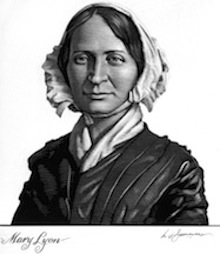
What Would Mary Lyon Say?
Many and varied voices have claimed to speak for Mount Holyoke’s founder.
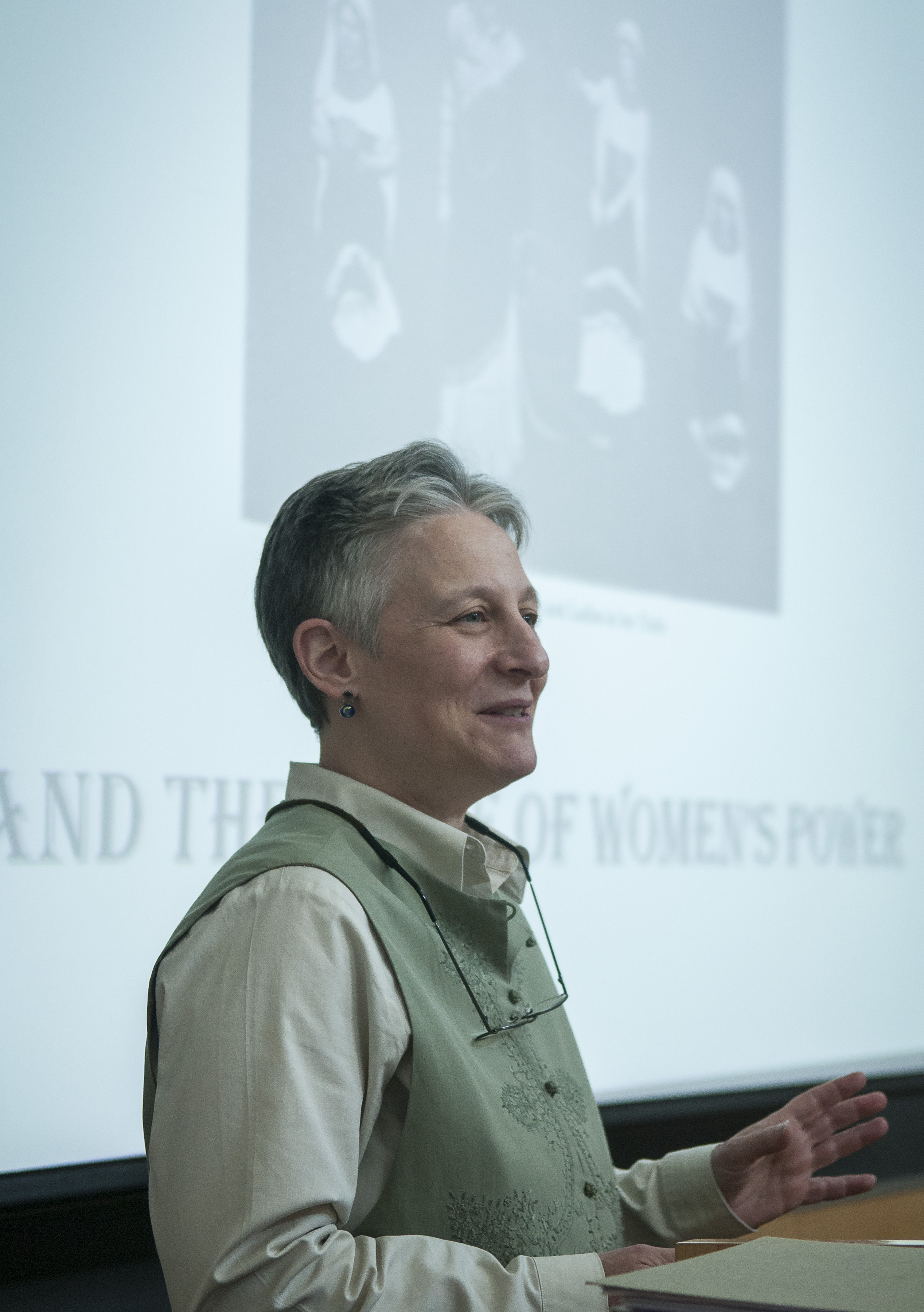
Associate Professor of History Mary Renda
Photo by Ben Barnhart
“Good morning, young ladies!” At the sound of those words “in a tone so like Miss Lyon’s,” the assembled daughters of Mount Holyoke rose in unison “with great enthusiasm.” It was 1887 and the alumnae of Mount Holyoke Female Seminary were gathered to celebrate the semicentennial of their alma mater’s founding. Eunice Caldwell Cowles, the Seminary’s first associate principal, had begged her audience’s indulgence before delivering the greeting: “Will you allow me,” she asked, referring to the dear companion of her youth, to serve “as her mouthpiece?” Cowles went on to speak for Mary Lyon on matters of religion, women’s leadership, and the importance of not deferring to the rich: welcome them and treat them well, but “don’t act as if you felt below them or above them.” What would Mary Lyon say to the idea of raising a fund to keep costs down? By all means, do it! Would Mary Lyon object to changing a part of the school’s name from Female Seminary to College? She would not, but if you do, then “be sure and have it a college.” Before and since, others have taken the liberty to serve as Mary Lyon’s mouthpiece. In 1862, at the Seminary’s twenty-fifth anniversary, male ministers spoke for her. They lauded and even envied the late educator’s skill as a preacher and considered that in her case, at least, there need be no controversy over a woman in the pulpit, for “Here was a pastor, on a salary of two hundred dollars…preaching five sermons a week, bringing…the Word of God, directly to affect every mind and heart.” High praise, indeed, but then, she was dead, and dead, self-denying Christian women had a special kind of power in the mouths of nineteenth-century American ministers.
From the range of such voices over the years, there emerges a veritable parade of Mary Lyons: the pious Christian, the frugal domestic head, the science educator, the progressive, the defender of universal human values, the volunteer for social justice, the conservative revolutionary, the feminist.
The seminary became a college shortly after Eunice Cowles’s loving impersonation; within a decade the College burned to the ground; and in 1891 President Mead instituted Founder’s Day. All provided occasions for the representatives of Mary Lyon’s legacy to speak in her name. From the range of such voices over the years, there emerges a veritable parade of Mary Lyons: the pious Christian, the frugal domestic head, the science educator, the progressive, the defender of universal human values, the volunteer for social justice, the conservative revolutionary, the feminist. To President Mary Woolley, in 1905, she was a “radical democrat”; to Woolley’s peace-movement friends in 1937, the year it was decided to put a man at Mount Holyoke’s helm upon Woolley’s retirement, Mary Lyon was an exemplar of women’s leadership, whose strength was captured in her comment on the College’s biblical motto (“That our daughters may be as cornerstones polished after the similitude of a palace”): “You cannot polish a piece of sponge, but you can polish a piece of steel.” A mere five years later, the pacifist’s choice metaphor materialized ironically in the christening of a liberty ship, the U.S.S. Mary Lyon. By 1997, a liberated Miss Lyon, with imaginary bloomers showing beneath the raised hem of her skirt, ran a “Marython” to support public education. There were words Mount Holyoke’s founder spoke that have less often, if ever, found their way into the mouths of latter-day Mary Lyons and champions of her legacy. Among these: her derogatory views of Irish immigrant servant girls whom the Seminary was able to exclude from its “household” thanks to a plan for students and teachers to cooperate in carrying out their own domestic labor; words to encourage full assimilation to Anglo-Saxon New England norms, spoken to a student body that included two Cherokee sisters who attended Mount Holyoke in the 1840s; words of remonstrance heard by the young abolitionist Lucy Stone, then a Seminary student, who placed unauthorized anti-slavery literature in the reading room; and Mary Lyon’s response, now lost to us, it seems, to another abolitionist plea to foster benevolence not only for those in distant lands, but also for those women suffering at the hands of American slave masters. These unrepeated words mark the limits of the program Mary Lyon was ready to fashion for Mount Holyoke. More able to imagine sending New England daughters to distant lands than to contemplate working on behalf of poor, immigrant, or African American women nearer by, she could not yet imagine the wider range of experiences, perspectives, and cultures that would come to animate the College and shape the work of its alumnae in struggles for justice in her own country as well as in the far corners of the continent and the world. What would Mary Lyon say? “Improve!” She could not have predicted the ways her beloved household would take that admonition to heart. And we are, by necessity, still at it.
—By Mary A. Renda
Mary A. Renda is an associate professor of history at Mount Holyoke College. This article appeared in the fall 2012 issue of the Alumnae Quarterly.
 Born in Buckland, Massachusetts, Mary Lyon was five years old when her father died and thirteen when her mother remarried and moved from the family home, taking some of her siblings, but leaving Mary to serve as housekeeper to her older brother, Aaron. With a small inheritance, a weekly wage paid by Aaron, and additional sums earned by teaching, sewing, and weaving, at twenty-one Mary Lyon made her way to Byfield, Massachusetts, to study under Joseph Emerson, an advocate for women’s education. There she met Zilpah Grant, with whom she subsequently taught in nearby Derry and Ipswich, and who became her beloved confidante and lifelong friend. While teaching at Grant’s Ipswich Female Seminary, she conceived a plan to found a new kind of school. Many women opened schools for young ladies, but they tended to exist only as long as that particular teacher taught. Mary Lyon envisioned a permanent institution with the highest educational standards, comparable to a college for men, available to the daughters of families of modest means. Lyon enlisted the support of ministers and other influential men, but she turned, too, to women to contribute what they could and thus to stand behind the enterprise. She drew public censure for going house to house, talking with men and women to raise funds for the school, but she understood her endeavor to be ordained by God. “I am doing great work,” she said, “I can not come down.”