


MHC Moment: August 2013
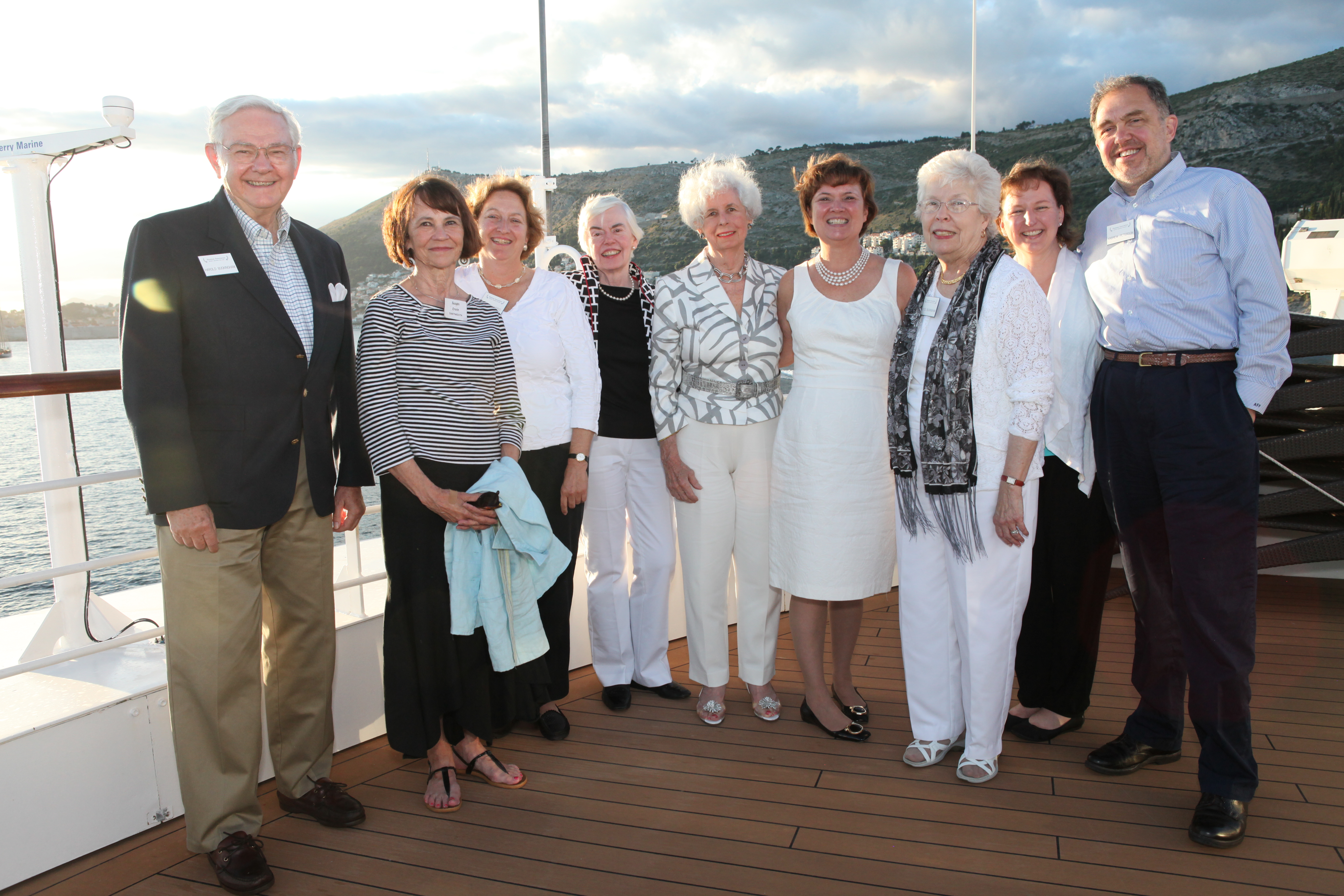
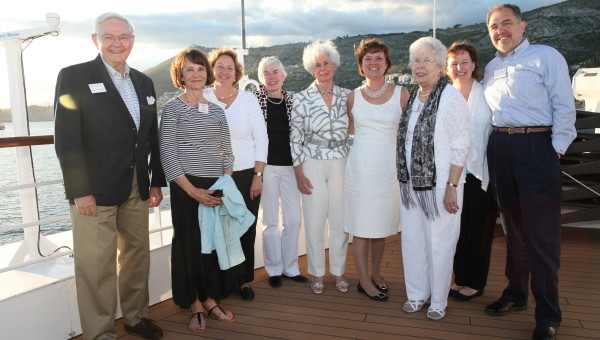
Pictured left to right: Harold Buckingham, Susan Ervin ’68, Laura Harris ’78, Martha Williams ’57, Patricia Scott ’53, Lynn Pasquerella ’80, Joyce Buckingham ’54, Alicia Harshfield ’85, Andrew Peterson
This summer President Pasquerella ’80 joined the alumnae trip, Coastal Life Cruising Along the Dalmatian Coast, which explored the Adriatic Sea’s stunning, island-dappled coast aboard a small, chartered ship. Together with alumnae, President Pasquerella visited historical sites such as the Diocletian’s palace in Croatia, the medieval fortifications of Kotor in Montenegro, and Dubrovnik’s restored Gothic and Romanesque quarters. Next summer, President Pasquerella will join the alumnae trip, In the Wake of the Vikings, a seven-day cruise from Glasgow, Scotland, to Copenhagen, Denmark.
» Learn more about the Alumnae Travel Program

Frequently Asked Questions

On August 12, Mount Holyoke College rolled out a new brand identity and marketing campaign: never fear / change. We asked all alumnae to join the #neverfearchange conversation via social media and you are! In the coming months, we will be rolling out additional ways to have your voice heard. As with all things new and bold, some of you love it, some of you question it, and some of you are going to wait and see if it grows on you. Here, we answer your most pressing questions about the never fear / change branding campaign.
» Read the press release about the new brand
» Watch the never fear / change video
» Follow the hashtag #neverfearchange on Twitter

Best of MHC Memes




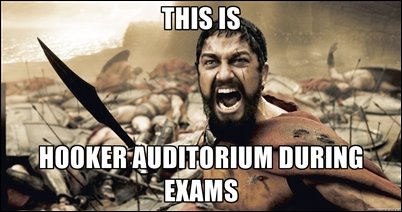





These are just a few of the best Mount Holyoke College memes that we came across on Tumblr and the Facebook page, Mount Holyoke College Memes. What’s a “meme” some of you may ask? Wikipedia defines an Internet meme as “a concept that spreads rapidly from person to person, usually in a humorous way.” Have a good idea for an MHC meme of your own? Use Meme Generator or Quickmeme.com and email them to quarterly@mtholyoke.edu. We’ll post the best ones to our Facebook page!
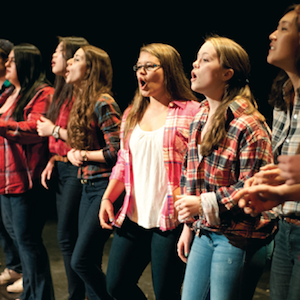
A Cappella: Sisters in Song
MHC A Cappella Groups Sing in Solidarity and Harmony
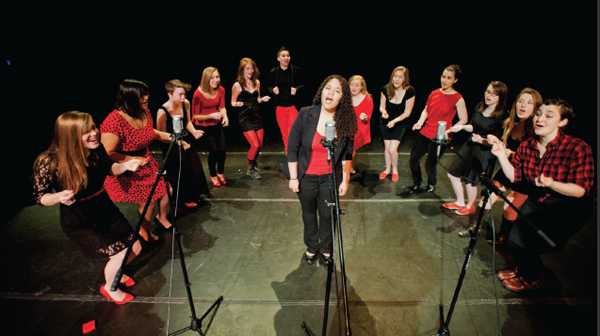
M&Cs
On a cool Sunday evening in September, Cassidy Bommer ’13 sat at a desk in her dorm room, checking email and trying to ignore her escalating heartbeat. They had told her to wait for a visit. They wouldn’t call or email unless the answer was “try again next time.” So far, no visit. 9:15 came, then 9:25. Still nothing. Giving up hope, she accepted her friend’s invitation to chat in the common room downstairs. As they sat together on an old couch, Bommer heard the sound of fingers snapping and voices singing down the hall. Someone else must have been chosen. But why was her companion smiling like that? A few seconds later, ten women rounded the corner and burst into the room, belting out “Up the Ladder to the Roof.” They finished with a flourish, and then one of the group stepped forward holding two ceremonial objects: a glass of milk in one hand and in the other, a plate piled improbably high with cookies. Bommer, pinned with shock to the couch, tried not to cry. She was in: the newest member of Mount Holyoke’s second-oldest a cappella group, the M&Cs. (And the cookies were oatmeal raisin, her favorite. They had remembered.)
Every fall and spring, four of the College’s five established a cappella groups hold open auditions. (Sacred Symphonies, in the welcoming spirit of a small church choir, opens itself to any spiritually minded student who loves to sing.) For the V8s, M&Cs, Diversions, and Nice Shoes, students try out during all-day Saturday auditions. “It’s grueling, but totally worth it,” says Molly Cox ’13 of Diversions. “You don’t always get in the first time, but anyone who keeps coming back will get into the best group for her. I did!” After callbacks and hours of spirited discussion among group members to reach unanimity, acceptances are finalized and the fun begins. New members of each group are informed according to a tradition begun more than seventy years ago: a rowdy welcoming song in the dorms and gifts ranging from a can of V8 juice to a rose to a candy Ring Pop.
Once a singer is in, a cappella membership often becomes the second most important part of her college life (assuming, of course, that the first is academics). The experience is “the most fun you’ll ever have,” says Bommer, now a musical codirector of the M&Cs, “but also a major investment of time.” Codirector Michaela Schwartz ’13 nods in passionate agreement. “We all sign a contract,” she says. “It is one serious commitment!”
A minimum of eight hours’ rehearsal per week is required, more if the October “Fam Jam” or the January “Ice Cappella” concert is coming up. Groups want to be ready to impress the entire campus during these signature events, when they all sing together in Chapin. The auditorium is packed not only with cheering students, staff, and faculty but also with clapping, dancing guests from other campuses, who call out encouragement and whoop their approval after songs like the V8s’ sexy “Put the Gun Down” or the M&Cs’ snappy “Trouble.” Choreography is minimal; a little swaying, a little stepping and changing positions, but nothing like the smooth, Michael Jackson-style moves and slick steps featured in the recent Hollywood comedy Pitch Perfect. Thanks to film and TV—Glee, anyone?—vocal groups are in fashion again, and so is the spectacle of fierce musical competition and gaudy showmanship. Not so with Mount Holyoke a cappella. There are no American Idol moments, no brassy, Broadway-here-I-come throw-downs. According to Cox, a “look at me, listen to me” attitude cuts no ice, even if you’ve got the pipes of Jennifer Hudson. What one finds instead is a refreshingly anti-diva, pro-sisterhood ethos shared by all the groups, regardless of style, history, repertoire, or musical “chops.”
Nothing But Voice
Traditional a cappella is nothing but voice, and singers believe that’s the magic of it. Attending a performance, one is struck by the purity of music created solely by female voices. Costumes, fancy dancing, and rock concert lighting are simply not needed. The fun is in discovering what the human voice can do. It can become a drum, a bell, a river of sound. Listen to the V8s back Dylan Young ’13 in “Love Me Like a River Does,” and you’ll hear it. There is delight in this unlike any other.

V8s
There is also delight in the stylistic differences among the groups. The V8s deeply respect their long tradition and take their musicianship seriously. Founded in 1942 and the oldest continuing all-female collegiate a cappella group in the country, the V8s took their name from the wartime slogan “V for Victory” and the number of women in the original lineup. The high-minded, talented V8s sang for servicemen at Westover Air Force Base and made it all the way to New York’s Stage Door Canteen, but reportedly refused to sing advertisements. “The V8s,” reads a 1954 Mount Holyoke News item, “do not wish to be confused with tomato juice or Ford engines.”
Their current style, which has evolved since the days of the Andrews Sisters, is described by members Audrey Hildebrandt ’16 and Chrislyn Laurore ’16 as “cool and smooth, but also edgy. We sound great singing jazz.” A good example is their version of Doris Day’s lustrous “Perhaps, Perhaps, Perhaps.” Another is—yes—the “Mount Holyoke Drinking Song,” still in the repertoire and still sounding smooth and tart as, well, a perfect martini.
The M&Cs also take their music seriously, and place a premium on opportunities for vocal development. Schwartz explains that the group “used to have a few soloists who did most of the showstoppers, but now we try to distribute them evenly. To learn to perform, you need to have a chance.” The M&Cs—whose name came about because founding members wanted to imply that food was available at performances— have no signature sound. When the group rehearses songs such as “Walking in Memphis,” by coffeehouse favorite Marc Cohn, or hip-hop icon Lauryn Hill’s version of “Can’t Take My Eyes Off You,” they demonstrate a playful versatility.
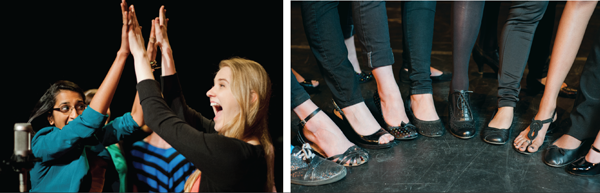
Nice Shoes
Nice Shoes works a little differently. The group formed in 1992 as “a reaction against the formalism of other a cappella groups,” according to members Sophie Beal ’13 and Zeeshan Margoob ’14. The most important question asked of potential members is not “What is your vocal training?” but “Why are you a feminist?” The ideal Shoe is a social-justice advocate who loves music that celebrates empowerment. Such as? “Talkin’ ’Bout a Revolution,” by Tracy Chapman, and “Not Ready to Make Nice,” by the Dixie Chicks, are good places to begin— and the Shoes’ renditions will take the top off your head. That, anyway, is the opinion shared by festive crowds of Nice Shoes alumnae who join the group to sing in Provincetown every fall for a week of “a cappella on the streets.”
Diversions
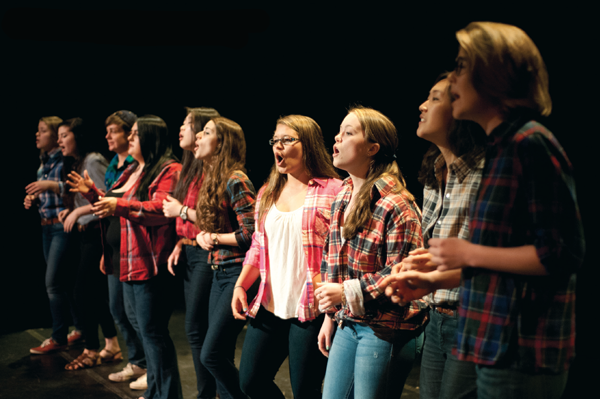
The musical style of Diversions offers yet another take on the a cappella form. Irreverent, lighthearted, and casual, the “Ds” prize camaraderie and fun. Performing a mix of popular, classic, and indie music from the Fleet Foxes to Amy Winehouse, the group’s members include classically trained singers and those with no special vocal training. Musical codirector Molly Cox describes their sound as “offbeat” and their vibe as unpretentious and open. They wear plaid for performances (at a recent show, plaid showed up in shirts, hair ties, skirts, even tights) and perform periodically in Vermont, where Cox lives, for people in retirement homes. Kimbra’s “Settle Down” or Amy Winehouse’s “Back to Black” to entertain retirees? Why not? It’s pure fun, for the singers and their audiences.
Sacred Symphonies
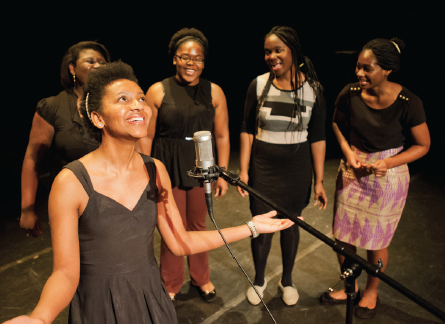
“Pure” describes the sound of Sacred Symphonies, the only Christian-oriented a cappella group on campus. Formed in 2005 by Priscilla Yohuno ’09, its members come from a variety of Christian traditions, and several came to Mount Holyoke from countries around the world. “It’s all about the joy of our faith,” says cochair Amanda Morton ’14. Sacred Symphonies sings South African spirituals, African American gospel, and praise songs from Ghana and Nigeria. Their purpose is to support one another in their spiritual practice, stand together as a faith community on campus, and celebrate their Christian belief in song. They work with both a music director and a prayer director, coming together in spiritual harmony at the start of rehearsals before embarking on musical harmony.
Then there is the newly formed RAAG, which aims to integrate Western and South Asian music into a cappella performances. The fledgling group shows every sign of becoming a sixth distinct sound on campus.
Different approaches, different musical styles. Does this ever mean disagreement? Controversy? Campus culture encourages outspokenness and strong opinions; a cappella is no exception. Take the idea of “blend.” Lindsay S. Pope ’07, a V8s alumna currently on MHC ’s music faculty, believes that “overreliance on blend can sometimes result in singers muting the strength of their voices to disappear into the group.” Some groups would strenuously argue this point; others believe that bringing each voice forward lets a group avoid what one singer called a girly as opposed to womanly sound.
More Than Music
While no one agrees on just what a “womanly” sound is, everyone agrees that a cappella develops both the voice and the person. It is an article of faith that many hours a week of vocal warm-ups, exercises, and ensemble singing are the best ways to strengthen your voice, in every sense of the word. Get used to being heard as a singer, and you get used to being heard as a human being.
Singers also feel that their “fellow members matter as much as family,” according to Morton. When they comfort you during your midterm breakdown, counsel you through choosing a major or an internship or the right topic for your honor thesis, and stand by you (literally) during your first nerve-wracking performances, they become your family away from home. “The Shoes are my community, my support system, my best friends,” says Zeeshan Margoob. “When I think of what Mount Holyoke means to me, I think of them first.”
If “family” means people who love and accept you as you are, as many singers say, it also means people who demand the best of you, especially when it’s your turn to lead. Michaela Schwartz believes that “peer leadership is more difficult than any other kind.” As a boss, a professor, a coach, one has automatic authority. Peer leaders need to earn respect. They need to communicate well, cultivate active participation, keep members on track during rehearsals, and learn to achieve consensus among up to fifteen highly opinionated, creative, and assertive personalities. “If you can do that,” says Schwartz, “you can do anything!”
Finally, there is the exceptionally strong a cappella alumnae network. V8s open doors for other V8s, M&Cs sing at alumnae weddings and parties. But perhaps the most dramatic example occurs when alumnae return to campus for a cappella reunions and join current members on stage. When the V8s held their gala fiftieth reunion on campus, the concert filled Blanchard to standing room only. “Seventy alumnae from multiple decades gathered on stage,” says Tacy Byham ’90, who cochaired the event. “We were graced with six of the original V8s, who remembered their parts perfectly after fifty years.” Those who attended the concert vividly recall the storm of applause—and the tears not only of those in the audience, but also of the performers on stage as they brought down the house with “Sunday, Monday, or Always.” Many also returned in 2012 for the V8s’ spring jam and seventieth anniversary, and some V8s are dreaming even now of a 100th anniversary in 2042.
A cappella alumnae also consistently remember, decades later, the thrill of that first welcome ritual, having good news delivered by a dozen singing women. “I cherish that memory,” says Nice Shoes alumna Clarisse Hart ’03. “If only the job and grad school acceptances I’ve received since then could’ve started with a song!” Imagine a world in which news of a job promotion, unexpected tax refund, or a seat on the city council is heralded by Mount Holyoke women materializing in your living room and belting out “Rugged But Right.” And if that gives you an idea, there are several a cappella groups just a mouse click away, ready and waiting to hear from you.
—By Leanna James Blackwell
—Photos by Julia Zave
This article appeared in the summer 2013 issue of the Alumnae Quarterly.
On the Road in China with Hope Justman ’64
A Chinese art history class taken in 1962 at Mount Holyoke changed the life of Hope Justman ’64. She fell in love with Chinese landscape painting, especially the masterpiece Emperor Ming Huang’s Journey to Shu. In the background was an ancient plank road clinging so precariously to sheer mountain cliffs as to seem more imaginary than real. Justman remembers wishing she could walk that road and follow wherever it led.
Thirty-seven years passed before she actually did this. Her interest in Chinese painting led to graduate studies in Chinese history, literature, and language. Unable to find a China-related teaching job, she became a court stenographer.
Justman first traveled to China in 1996. By then she had started a landscaping business, spending the spring and summer mowing lawns and listening to Mandarin Chinese instructional tapes via headphones. When the weather began to cool and work slowed, Justman left her Philadelphia home and spent the winter in China. As Gail Humphries ’64 says, “Hope can’t stay away. She’s magnetically drawn to these people and the adventure of her life.”
-
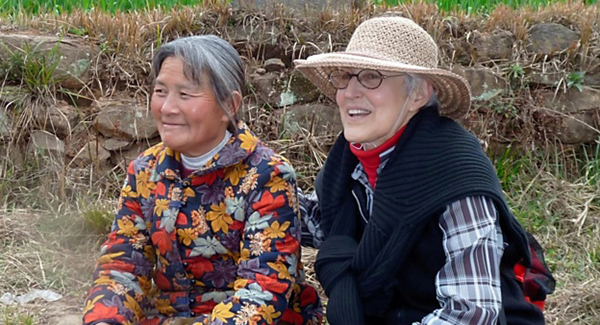
- Hope Justman ’64 with Chinese farmer Photo by Wendy Lycan Jackson ’64
-

- Man carrying wood along ancient Chinese road Photo by Wendy Lycan Jackson ’64
-

- Paved roads have replaced most of traditional flagstone roads in China. Photo by Wendy Lycan Jackson ’64
-

- Plowing outside Tantou, China Photo byHope Justman
-
- 2011 China tour group led by Hope Justman Photo by Wendy Lycan Jackson ’64
-

- Outside Puan, China Photo by Hope Justman
Discovering the Ancient Roads
During Justman’s third visit, wanting to see the more traditional Chinese countryside, she followed the route taken by a traveler in 1910. For the first three days, she did this by bus. But on the fourth day there was no bus and she had to walk to the next town. Thus she discovered her first old Imperial road. “Two thousand years ago, the entire country was linked by more than 25,000 miles of flagstone roads,” she says. Most have been replaced by modern highways, but in the mountains of Western China, fragments of the old roads remain.
Seeking and hiking ancient pathways in the provinces of Yunnan, Sichuan, Guizhou, and Shaanxi became her link to traditional China. Here lie villages where people live much as they have for thousands of years. “I fell in love with old roads,” says Justman. “Every year I would go back and try to find more of them.”
The Chinese are very proud of their ancient culture and temples, but this pride does not extend to their historic roads. Many rural Chinese think themselves old-fashioned and behind the times, often referring to themselves as luòhòu, meaning “backward.” Improving their lifestyle also means improving their roads. In many villages, people can only bring in what they carry on their backs or on a donkey. Paved roads allow them to drive trucks right up to their doors, bringing construction material to modernize their houses along with color TV sets and washing machines. Thus, when villagers improve access to their village, old flagstones disappear under cement.
Sharing “Her” China with Alumnae
In 2007, Justman, by then a seasoned expert, published a comprehensive travel book, Guide to Hiking China’s Old Road to Shu. It is filled with tips including where to find local guides, hotels, transportation, and restaurants, and lists helpful phrases for non-Chinese-speakers. The book is periodically updated at chinasgreatroads.com.
The book, and Justman’s repeated visits, have raised interest in the old roads among Chinese travelers. Many locals are now aware of the historical value and tourism potential of their area. “By coming there, I have done some good,” acknowledges Justman, noting that two towns have promoted the road to Shu as a tourist attraction and applied for heritage status from the government.
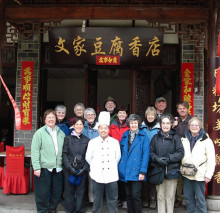
Those towns have become a destination for urban Chinese visitors. And since 2011, Justman has twice led MHC alumnae along the old roads. After a chance encounter at one College reunion, Justman—who knew China—teamed up with Jane Shilling Emerson ’64—who knows tours—to organize the expeditions. Traveler Mary Dee Beall ’64 says, “Hope’s respect for the people and their culture radiates from her, and she attracts a crowd wherever she goes.”
Justman particularly enjoys leading the groups along a reconstructed plank road in a narrow gorge on the Jialing River. It turns out the road along the sheer cliff in the painting was not imaginary after all.
—By Lauren Quirici FP ’14